Showing posts with label L. Show all posts

Thursday, December 18, 2008

Luxembourg

Luxembourg

Grand Duchy of Luxembourg
Alternative: Luxembourg
Großherzogtum Luxemburg (German)
Grand-Duché de Luxembourg (French)
Groussherzogtum Lëtzebuerg (Luxembourgish)
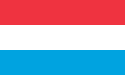
Flag of Luxembourg Coat of arms of Luxembourg
Flag Coat of arms
Motto: "Mir wëlle bleiwe wat mir sinn" (Luxembourgish)
"We want to remain what we are"
Anthem: Ons Heemecht
"Our Homeland"

Royal anthem: De Wilhelmus 1
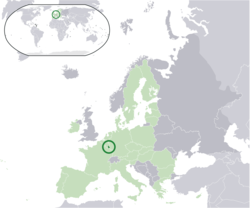
Location of Luxembourg
Capital
(and largest city)
Luxembourg
49°36′N 6°7′E / 49.6, 6.117
Official languages German, French, Luxembourgish (de jure since 1984)
Demonym Luxembourgers
Government Parliamentary democracy and Constitutional grand duchy
- Grand Duke Grand Duke Henri (List)
- Prime minister Jean-Claude Juncker (List)
Independence
- From French empire (Treaty of Paris ) 9 June 1815
- 1st Treaty of London 19 April 1839
- 2nd Treaty of London 11 May 1867
- End of personal union 23 November 1890
EU accession March 25, 1957
Area
- Total 2,586.4 km2 (175th)
998.6 sq mi
- Water (%) negligible
Population
- 2007 estimate 480,222 (-)
- 2001 census 439,539
- Density 186/km2 (59th)
481/sq mi
GDP (PPP) 2007 estimate
- Total $38.261 billion[1] (97th)
- Per capita $79,659[1] (IMF) (1st)
GDP (nominal) 2007 estimate
- Total $49.531 billion[1] (65th)
- Per capita $103,124[1] (IMF) (1st)
HDI (2004) 0.945 (high) (18th)
Currency Euro (€)2 (EUR)
Time zone CET (UTC+1)
- Summer (DST) CEST (UTC+2)
Drives on the right
Internet TLD .lu3
Calling code 352
1 Not the same as the Het Wilhelmus of the Netherlands.
2 Before 1999: Luxembourgian franc.
3 The .eu domain is also used, as it is shared with other European Union member states.
Charles IV, the 14th century Holy Roman Emperor and king of Bohemia from the House of Luxembourg.[2]

Luxembourg /ˈlʌksəmbɝːɡ/ (Luxembourgish: Groussherzogtum Lëtzebuerg, French: Grand-Duché de Luxembourg, German: Großherzogtum Luxemburg) is a small landlocked country in western Europe, bordered by Belgium, France, and Germany. Luxembourg has a population of under half a million people in an area of approximately 2,586 square kilometres (999 sq mi).[3]

Luxembourg is a parliamentary representative democracy with a constitutional monarch, ruled by a Grand Duke. It is the world's only remaining sovereign Grand Duchy. The country has a highly developed economy, with the second highest Gross Domestic Product per capita in the world (U.S. Central Intelligence Agency 2007 est.). Its historic and strategic importance dates back to its founding as a Roman era fortress site and Frankish count's castle site in the Early Middle Ages. It was an important bastion along the Spanish road when Spain was the principal European power influencing the whole western hemisphere and beyond in the 14th–17th centuries.

Luxembourg is a founding member of the European Union, NATO, the United Nations, Benelux, and the Western European Union, reflecting the political consensus in favour of economic, political, and military integration. The city of Luxembourg, the capital and largest city, is the seat of several institutions and agencies of the European Union.

Luxembourg lies on the cultural divide between Romance Europe and Germanic Europe, borrowing customs from each of the distinct traditions. Luxembourg is a trilingual country; German, French and Luxembourgish are official languages. Although a secular state, Luxembourg is predominantly Roman Catholic.

Contents

1 History
  • 2 Government and politics
  • 3 Military
  • 4 Districts, cantons, and communes
    • 4.1 Districts
  • 5 Geography and climate
  • 6 Demographics
    • 6.1 Ethnicity
    • 6.2 Language
    • 6.3 Religion
  • 7 Economy
  • 8 Culture
    • 8.1 Media
  • 9 See also
  • 10 References
    • 10.1 Footnotes
  • 11 External links

History

Main article: History of Luxembourg
The three Partitions of Luxembourg have greatly reduced Luxembourg's territory.

The recorded history of Luxembourg begins with the acquisition of Lucilinburhuc[4] (today Luxembourg Castle) by Siegfried, Count of Ardennes in 963. Around this fort, a town gradually developed, which became the centre of a small state of great strategic value. In 1437, the House of Luxembourg suffered a succession crisis, precipitated by the lack of a male heir to assume the throne, that led to the territory being sold to Philip the Good of Burgundy.[5] In the following centuries, Luxembourg's fortress was steadily enlarged and strengthened by its successive occupants, the Bourbons, Habsburgs, Hohenzollerns, and the French, among others. After the defeat of Napoleon in 1815, Luxembourg was disputed between Prussia and the Netherlands. The Congress of Vienna formed Luxembourg as a Grand Duchy in personal union with the Netherlands. Luxembourg also became a member of the German Confederation, with a Confederate fortress manned by Prussian troops.[6]

The Belgian Revolution of 1830–1839 reduced Luxembourg's territory by more than half, as the predominantly francophone western part of the country was transferred to Belgium. Luxembourg's independence was reaffirmed by the 1839 First Treaty of London. In the same year, Luxembourg joined the Zollverein.[7] Luxembourg's independence and neutrality were again affirmed by the 1867 Second Treaty of London, after the Luxembourg Crisis nearly led to war between Prussia and France.[8] After the latter conflict, the Confederate fortress was dismantled.[9]

The King of the Netherlands remained Head of State as Grand Duke of Luxembourg, maintaining personal union between the two countries until 1890. At the death of William III, the Dutch throne passed to his daughter Wilhelmina, while Luxembourg (at that time restricted to male heirs by the Nassau Family Pact) passed to Adolph of Nassau-Weilburg.[10]

Luxembourg was invaded and occupied by Germany during the First World War, but was allowed to maintain its independence and political mechanisms. It was again invaded and subject to German occupation in the Second World War in 1940, and was formally annexed into the Third Reich in 1942.

During World War II, Luxembourg abandoned its policy of neutrality, when it joined the Allies in fighting Germany. Its government, exiled to London, set up a small group of volunteers who participated in the Normandy invasion. It became a founding member of the United Nations in 1946, and of NATO in 1949. In 1957, Luxembourg became one of the six founding countries of the European Economic Community (later the European Union), and, in 1999, it joined the euro currency area. In 2005, a referendum on the EU treaty establishing a constitution for Europe was held in Luxembourg.[11]

Government and politics

Main article: Politics of Luxembourg

Luxembourg is a parliamentary democracy headed by a constitutional monarch. Under the constitution of 1868, executive power is exercised by the Grand Duke and the cabinet, which consists of several other ministers. The Governor has the power to dissolve the legislature and reinstate a new one, as long as the Grand Duke has judicial approval. However, since 1919, sovereignty has resided with the Supreme Court.[12]

Legislative power is vested in the Chamber of Deputies, a unicameral legislature of sixty members, who are directly elected to five-year terms from four constituencies. A second body, the Council of State (Conseil d'État), composed of twenty-one ordinary citizens appointed by the Grand Duke, advises the Chamber of Deputies in the drafting of legislation.[13]

The Grand Duchy has three lower tribunals (justices de paix; in Esch-sur-Alzette, the city of Luxembourg, and Diekirch), two district tribunals (Luxembourg and Diekirch) and a Superior Court of Justice (Luxembourg), which includes the Court of Appeal and the Court of Cassation. There is also an Administrative Tribunal and an Administrative Court, as well as a Constitutional Court, all of which are located in the capital.

Military

Main article: Military of Luxembourg

Luxembourg's contribution to its defence and to NATO consists of a small army (currently consisting of around 800 people). As a landlocked country, it has no navy, and it has no air force, except for the fact that the seventeen NATO AWACS aeroplanes are registered as aircraft of Luxembourg for convenience.[14] In a joint agreement with Belgium, both countries have put forth funding for one A400M military cargo plane, currently on order. Luxembourg still jointly maintains three NATO Boeing 707 model TCAs for cargo and training purposes based in NATO Air Base Geilenkirchen.[14]

Districts, cantons, and communes

Districts of Luxembourg
Main articles: Districts of Luxembourg, Cantons of Luxembourg, and Communes of Luxembourg
Further information: Administrative divisions of Luxembourg

Luxembourg is divided into 3 districts, which are further divided into 12 cantons and then 116 communes. Twelve of the communes have city status, of which the city of Luxembourg is the largest.

Districts

The districts are

The largest towns are Luxembourg, Esch-sur-Alzette, Dudelange, and Differdange.

1. Diekirch 2. Grevenmacher 3. Luxembourg

Geography and climate

Main article: Geography of Luxembourg

Luxembourg is one of the smallest countries in Europe, and ranked 175th in size of all the 194 independent countries of the world; the country is about 2,586 square kilometres (998 sq mi) in size, and measures 82 km (51 miles) long and 57 km (35 miles) wide. To the east, Luxembourg borders the German Bundesländer of Rhineland-Palatinate and Saarland, and, to the south, it borders the French région of Lorraine. The Grand Duchy borders the Belgian Walloon Region, in particular the latter's provinces of Luxembourg and Liège, more in particular the German-speaking Community of Belgium, to the west and to the north respectively.

The northern third of the country is known as the 'Oesling', and forms part of the Ardennes. It is dominated by hills and low mountains, including the Kneiff, which is the highest point, at 560 metres (1,837 ft). The region is sparsely populated, with only one town (Wiltz) with a population of more than four thousand people.

Luxembourg's climate is characterised by mild temperatures and high precipitation.
Countryside of Alscheid.

The southern two-thirds of the country is called the "Gutland", and is more densely populated than the Oesling. It is also more diverse, and can be divided into five geographic sub-regions. The Luxembourg plateau, in south-central Luxembourg, is a large, flat, sandstone formation, and the site of the city of Luxembourg. Little Switzerland, in the east of Luxembourg, has craggy terrain and thick forests. The Moselle valley is the lowest-lying region, running along the south-eastern border. The Red Lands, in the far south and southwest, are Luxembourg's industrial heartland and home to many of Luxembourg's largest towns.

The border between Luxembourg and Germany is formed by three rivers: the Moselle, the Sauer, and the Our. Other major rivers are the Alzette, the Attert, the Clerve, and the Wiltz. The valleys of the mid-Sauer and Attert form the border between the Gutland and the Oesling.

Luxembourg has a marine west coast climate (Köppen: Cfb), marked by high precipitation, particularly in late summer.[15]

Demographics

Main article: Demographics of Luxembourg

Ethnicity

The people of Luxembourg are called Luxembourgers.[16] The native population has a Celtic base with a French and Germanic blend.[17] The immigrant population increased in the twentieth century due to the arrival of immigrants from Belgium, France, Germany, Italy, and Portugal, with the majority coming from this last country. In the 2001 census, there were 58,657 inhabitants with Portuguese nationality.[18] Since the beginning of the Yugoslav wars, Luxembourg has seen many immigrants from Bosnia and Herzegovina, Montenegro, and Serbia. Annually, over 10,000 new immigrants arrive in Luxembourg, mostly from EU states, as well and Eastern Europe. As of 2000, there were 162,000 immigrants in Luxembourg, accounting for 37% of the total population. There were an estimated 5,000 undocumented immigrants, including asylum seekers, in Luxembourg as of 1999.[19]

Language

Main article: Languages of Luxembourg

Three languages are recognised as official in Luxembourg: French, German, and Luxembourgish, a Franconian language of the Moselle region very similar to the local German dialect spoken in the neighbouring part of Germany, except that it includes more borrowings from French. So in principle Luxembourgish is a High German dialect with the status of a national language. Apart from being one of the three official languages, Luxembourgish is also considered the national language of the Grand Duchy; it is the mother tongue or "language of the heart" for nearly all Luxembourgers.

Each of the three languages is used as the primary language in certain spheres. Luxembourgish is the language that Luxembourgers generally speak to each other, but it is not often written down. Most official (written) business is carried out in French. German is usually the first language taught in school and is the language of much of the media and of the church.[20] In fact, around 85% of all articles published in Luxembourg are in the German language, 12% are in French and only 3% in Luxembourgish.

Luxembourg's education system is trilingual: the first years of primary school are in Luxembourgish, before changing to German, while secondary school, the language of instruction changes to French.[21] However, as proficiency in all three languages is required for graduation from secondary school, half the students leave school without a certified qualification, with the children of immigrants being particularly disadvantaged.[22]

In addition to the three official languages, English is taught in the compulsory schooling and much of the population of Luxembourg can speak English, at any rate in Luxembourg City. Portuguese and Italian, the languages of the two largest immigrant communities, are also spoken by large parts of the population, but by relatively few from outside their respective communities.

Religion

Main article: Religion in Luxembourg

Luxembourg is a secular state, but the state recognises certain religions as officially-mandated religions. This gives the state a hand in religious administration and appointment of clergy, in exchange for which the state pays certain running costs and wages. Currently, religions covered by such arrangements are Roman Catholicism, Judaism, Greek Orthodoxy, Anglicanism, Russian Orthodoxy, Protestantism and Islam.[23]

Since 1980 it has been illegal for the government to collect statistics on religious beliefs or practices.[24] It is estimated by the CIA Factbook that 87% of Luxembourgers are Catholics, the remaining 13% being made up of Protestants, Orthodox Christians, Jews, Muslims and those of other or no religion.[25]

According to the most recent Eurobarometer Poll 2005,[26] 44% of Luxembourg citizens responded that "they believe there is a God", whereas 28% answered that "they believe there is some sort of spirit or life force" and 22% that "they do not believe there is any sort of spirit, god, or life force".

Economy

Main article: Economy of Luxembourg
Luxembourg is a member state of the European Union and part of the Eurozone.

Luxembourg's stable, high-income economy features moderate growth, low inflation, and low unemployment. The industrial sector, which was dominated until the 1960s by steel, has diversified to include chemicals, rubber, and other products. During the past decades, growth in the financial sector has more than compensated for the decline in steel. Services, especially banking and other financial exports, account for the majority of economic output. Luxembourg is the world's second largest investment fund center (after the USA), the most important private banking center in the Eurozone and Europe's leading center for reinsurance companies. Moreover, the Luxembourgish government has tried to attract internet start-ups. Skype, Jajah and eBay are only a few of the many internet companies that have shifted their local or global headquarters to Luxembourg.

Agriculture is based on small, family-owned farms. Luxembourg has especially close trade and financial ties to Belgium and the Netherlands (see Benelux), and as a member of the EU it enjoys the advantages of the open European market. Luxembourg possesses the highest GDP per capita in the world (US$87,995 as of 2006),[25] the eighteenth highest Human Development Index, and the fourth highest rated in the quality of life index.[27] As of March 2006, unemployment is 4.8% of the labor force.[28] For the fiscal year of 2005 and 2006, Luxembourg has run a budget deficit for the first time in many years, mostly because of slower international economic growth.[29]

Culture

Main article: Culture of Luxembourg
Edward Steichen, Luxembourgish photographer and painter.
Notre-Dame Cathedral, Luxembourg.

Luxembourg has been overshadowed by the culture of its neighbours, although, having been for much of its history a profoundly rural country, it retains a number of folk traditions. There are several notable museums, mostly located in the capital; these include the National Museum of History and Art (MNHA), the History Museum of the City of Luxembourg, and the new Grand Duke Jean Museum of Modern Art (Mudam). The National Museum of Military History (MNHM) in Diekirch is especially known for its representations of the Battle of the Bulge. The city of Luxembourg itself is on the UNESCO World Heritage List, on account of the historical importance of its fortifications.

The country has produced some internationally known artists, including the painters Joseph Kutter and Michel Majerus, as well as the photographer Edward Steichen. Steichen's The Family of Man exhibition is now permanently housed in Clervaux, and it has been placed on UNESCO's Memory of the World register.

Luxembourg was the first city to be named European Capital of Culture twice. The first time was in 1995. In 2007, the European Capital of Culture was to be a cross-border area consisting of the Grand Duchy of Luxembourg, the Rheinland-Pfalz and Saarland in Germany, the Walloon Region and the German-speaking part of Belgium, and the Lorraine area in France. The event was an attempt to promote mobility and the exchange of ideas, crossing borders in all areas, physical, psychological, artistic and emotional.

Media

For many people in other parts of Europe, Luxembourg is best known for its radio and television stations, Radio Luxembourg and the RTL Group, Europe's largest TV, radio and production company. It is also the uplink home of SES Astra, carrier of major European satellite services for Germany and Britain.

Studies show that the country Luxembourg consumes the most alcohol, according to Guinness World Records 2008. In the year 2003, on average 2.8 gallons (12.6 litres) of pure alcohol was consumed per citizen. This however is a statistical phenomenon, not actual, as the low taxes on alcohol, cigarettes and petrol in Luxembourg mean that Belgians, French and Germans living close to the border buy these products in Luxembourg, and increase the sales without being counted as consumers in the statistical analyses.

Lithuania

Lithuania

Republic of Lithuania
Lietuvos Respublika
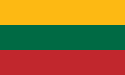
Flag of Lithuania Coat of arms of Lithuania
Flag Coat of arms
Motto: "Tautos jėga vienybėje"
"The strength of the nation lies in unity"
Anthem: Tautiška giesmė
Location of Lithuania
Location of Lithuania (orange)

– on the European continent (camel & white)
– in the European Union (camel)  

Capital
(and largest city)
Vilnius
54°41′N 25°19′E / 54.683, 25.317
Official languages Lithuanian
Demonym Lithuanian
Government Semi-presidential republic
- President Valdas Adamkus
- Prime Minister Andrius Kubilius
- Seimas Speaker Arūnas Valinskas
Independence from the Russian Empire (1918)
- Lithuania mentioned February 14, 1009
- Statehood July 6, 1253
- Personal union with Poland February 2, 1386
- Polish-Lithuanian Commonwealth declared 1569
- Russian/Prussian occupation 1795
- Independence declared February 16, 1918
- 1st Soviet occupation June 15, 1940
- 2nd Soviet occupation 1944
- Independence restored March 11, 1990
EU accession 1 May 2004
Area
- Total 65,200 km2 (123rd)
25,173 sq mi
- Water (%) 1,35%
Population
- 2007 estimate 3,369,600 (130th)
- Density 52/km2 (120th)
134/sq mi
GDP (PPP) 2007 estimate
- Total $59.644 billion[1] (75th)
- Per capita $17,661 (46th)
GDP (nominal) 2008 IMF April estimate
- Total $48.132 billion [2] (75th)
- Per capita $14, 273 (39th)
Gini (2003) 36 (medium)
HDI (2007) ▲ 0.862 (high) (43rd)
Currency Lithuanian litas (Lt) (LTL)
Time zone EET (UTC+2)
- Summer (DST) EEST (UTC+3)
Date formats yyyy.mm.dd (CE)
Drives on the right
Internet TLD .lt1
Calling code 370
1 Also .eu, shared with other European Union member states.

Lithuania [ˌlɪθuˈeɪniə], officially the Republic of Lithuania (Lithuanian: Lietuvos Respublika) is a country in Balticum, in Europe,[2] and is one of the three Baltic states. Situated along the southeastern shore of the Baltic Sea, it shares borders with Latvia to the north, Belarus to the southeast, Poland, and the Russian exclave of the Kaliningrad Oblast to the southwest. Lithuania is a member of NATO and of the European Union. Its population is 3.4 million. Its capital and largest city is Vilnius.

During the 14th century, Lithuania was the largest country in Europe: present-day Belarus, Ukraine, and parts of Poland and Russia were territories of the Grand Duchy of Lithuania. With the Lublin Union of 1569 Poland and Lithuania formed a new state, the Polish–Lithuanian Commonwealth. The Commonwealth lasted more than two centuries, until neighboring countries systematically dismantled it from 1772 to 1795, with the Russian Empire annexing most of Lithuania's territory. In the wake of the First World War, Lithuania's Act of Independence was signed on February 16, 1918, declaring the re-establishment of a sovereign state. Starting in 1940, Lithuania was occupied first by the Soviet Union then Nazi Germany. As World War II neared its end in 1944 and the Nazis retreated, the Soviet Union reoccupied Lithuania. On March 11, 1990, Lithuania became the first Soviet republic to declare its renewed independence.

Present-day Lithuania has one of the fastest growing economies in the European Union. Lithuania became a full member of the Schengen Agreement on 21 December 2007.[3] In 2009, Lithuania will celebrate the millennium of its name.

Contents

1 History
  • 2 Politics
  • 3 Counties, municipalities and elderates
    • 3.1 Counties
    • 3.2 Municipalities
    • 3.3 Elderates
    • 3.4 Possible changes of administrative division
  • 4 Geography
  • 5 Economy
  • 6 Education
  • 7 Infrastructure
  • 8 Demographics
    • 8.1 Ethnic composition
    • 8.2 Health and welfare
    • 8.3 Largest cities
  • 9 Religion
  • 10 Culture
  • 11 See also
  • 12 Notes and references
  • 13 External links

History

Main article: History of Lithuania

The first written mention of Lithuania is found in a medieval German manuscript, the Quedlinburg Chronicle, on 14 February 1009. The Lithuanian lands were united by Mindaugas in 1236, and neighbouring countries referred to it as "the state of Lithuania." The official coronation of Mindaugas as King of Lithuania was on July 6, 1253, and the official recognition of Lithuanian statehood as the Kingdom of Lithuania.[4]

Vytautas the Great, under his reign Lithuania reached zenith of power (17th century painting)

During the early period of Vytautas the Great (1316–1430), the state occupied the territories of present-day Belarus, Ukraine, and parts of Poland and Russia.[5] By the end of the fourteenth century, Lithuania was the largest country in Europe, and was also the only remaining pagan state.[6] The Grand Duchy of Lithuania stretched across a substantial part of Europe, from the Baltic to the Black Sea. Lithuanian nobility, city dwellers and peasants accepted Christianity in 1386, following Poland's offer of its crown to Jogaila, the Grand Duke of Lithuania. Grand Duke Jogaila was crowned King of Poland on February 2, 1386. Lithuania and Poland were joined into a personal union, as both countries were ruled by the same Gediminas branch, the Jagiellon dynasty.

In 1401, the formal union was dissolved as a result of disputes over legal terminology, and Vytautas, the cousin of Jogaila, became the Grand Duke of Lithuania. Thanks to close cooperation, the armies of Poland and Lithuania achieved a great victory over the Teutonic Knights in 1410 at the Battle of Grunwald, one of the largest battles of mediaeval Europe.

A royal crown had been bestowed upon Vytautas in 1429 by Sigismund, the Holy Roman Emperor, but Polish magnates prevented his coronation by seizing the crown as it was being brought to him.[7] New attempts were made to send a crown, but a month later Vytautas died as the result of an accident.[8]

As a result of the growing centralised power of the Grand Principality of Moscow, in 1569, Lithuania and Poland formally united into a single state called the Polish–Lithuanian Commonwealth. As a member of the Commonwealth, Lithuania retained its institutions, including a separate army, currency and statutory law which was digested in three Statutes of Lithuania.[9] In 1795, the joint state was dissolved by the third Partition of the Commonwealth, which forfeited its lands to Russia, Prussia and Austria, under duress. Over ninety percent of Lithuania was incorporated into the Russian Empire and the remainder into Prussia. Between 1868 and 1914, approximately 635,000 people, almost 20% of the population, left Lithuania.[10]

The original 20 members of the Council of Lithuania after signing the Act of Independence of Lithuania, February 16, 1918

After a century of occupation, Lithuania re-established its independence on February 16, 1918. The official government from July through November 1918 was quickly replaced by a republican government. From the outset, the newly independent Lithuania's foreign policy was dominated by territorial disputes with Poland (over the Vilnius region and the Suvalkai region) and with Germany (over the Klaipėda region or Memelland). Most obviously, the Lithuanian constitution designated Vilnius as the nation's capital, even though the city itself lay within Polish territory as a result of a general election. At the time, Poles and Jews made up a majority of the population of Vilnius, with a small Lithuanian minority of only 0.8%.[11] In the Klaipėda Region census of 1925, over 41% of the population declared themselves German.[12] In 1920 the capital was relocated to Kaunas, which was officially designated the provisional capital of Lithuania. (See History of Vilnius for more details.)[13]

In June 1940, around the beginning of World War II, the Soviet Union occupied and annexed Lithuania in accordance with the Molotov-Ribbentrop Pact.[14][15] A year later it came under German occupation. After the retreat of the German armed forces (Wehrmacht), Lithuania was reoccupied by the Soviet Union in 1944.

From 1944 to 1952 approximately 100,000 Lithuanians participated in partisan fights against the Soviet system and the Red Army. More than twenty thousand partisans ("forest brothers") were killed in those battles and many more were arrested and deported to Siberian GULAGs. Lithuanian historians view this period as a war of independence against the Soviet Union.

Map showing changes in the territory of Lithuania from the 13th century to the present day.

During the Soviet and Nazi occupations between 1940 and 1944, Lithuania lost over 780,000 residents. Among them were around 190,000 Lithuanian Jews (91% of the pre-war Jewish community), one of the highest total mortality rates of the Holocaust. An estimated 120,000 to 300,000[16] were killed by Soviets or exiled to Siberia, while others had been sent to German forced labour camps or chose to emigrate to western countries.

Forty-six years of Soviet occupation ended with the advent of perestroika and glasnost in the late 1980s. Lithuania, led by Sąjūdis, an anti-communist and anti-Soviet independence movement, proclaimed its renewed independence on March 11, 1990. Lithuania was the first Soviet republic to do so, though Soviet forces unsuccessfully tried to suppress this secession. The Red Army attacked the Vilnius TV Tower on the night of January 13, 1991, an act that resulted in the death of 13 Lithuanian civilians.[17] The last Red Army troops left Lithuania on August 31, 1993 — even earlier than they departed from East Germany.

On February 4, 1991, Iceland became the first country to recognize Lithuanian independence. Sweden was the first to open an embassy in the country. The United States of America never recognized the Soviet claim to Lithuania, Latvia and Estonia. Russia currently refuses to recognize the occupation of Lithuania, claiming that Lithuanians decided to join the Soviet Union voluntarily, although Russia signed a treaty with Lithuania before the disintegration of the USSR which acknowledged Lithuania's forced loss of sovereignty at the hands of the Soviets, thereby recognizing the occupation.

Lithuania joined the United Nations on September 17, 1991, and on May 31, 2001, it became the 141st member of the World Trade Organization. Since 1988, Lithuania has sought closer ties with the West, and so on January 4, 1994, it became the first of the Baltic states to apply for NATO membership. On March 29, 2004, it became a NATO member, and on May 1, 2004, Lithuania joined the European Union.

Politics

Current President of Lithuania Valdas Adamkus (right) meeting with Vice President of the United States Dick Cheney in Vilnius in May 2006.
Main article: Politics of Lithuania

Since Lithuania declared independence on March 11, 1990, it has maintained strong democratic traditions. In the first general elections after the independence on October 25, 1992, 56.75% of the total number of voters supported the new constitution.[18] There were heavy debates concerning the constitution, especially the role of the president. Drawing from the interwar experiences, many different proposals were made ranging from a strong parliamentary government to a presidential system similar to the one in the United States. A separate referendum was held on May 23, 1992 to gauge public opinion on the matter and 41% of all the eligible voters supported the restoration of the President of Lithuania.[18] Eventually a semi-presidential system was agreed upon.[19]

The Lithuanian head of state is the President, elected directly for a five-year term, serving a maximum of two consecutive terms. The post of president is largely ceremonial; main policy functions however include foreign affairs and national security policy. The president is also the military commander-in-chief. The President, with the approval of the parliamentary body, the Seimas, also appoints the prime minister and on the latter's nomination, appoints the rest of the cabinet, as well as a number of other top civil servants and the judges for all courts. The judges of the Constitutional Court (Konstitucinis Teismas), who serve nine-year terms, are appointed by the President (three judges), the Chairman of the Seimas (three judges) and the Chairman of the Supreme Court (three judges). The unicameral Lithuanian parliament, the Seimas, has 141 members who are elected to four-year terms. 71 of the members of this legislative body are elected in single constituencies, and the other 70 are elected in a nationwide vote by proportional representation. A party must receive at least 5% of the national vote to be represented in the Seimas.

Counties, municipalities and elderates

Lithuania is subdivided into ten counties and sixty municipalities.
Main articles: Counties of Lithuania, Municipalities of Lithuania, and Elderships of Lithuania

The current administrative division was established in 1994 and modified in 2000 to meet the requirements of the European Union. Lithuania has a three-tier administrative division: the country is divided into 10 counties (Lithuanian: singular — apskritis, plural — apskritys) that are further subdivided into 60 municipalities (Lithuanian: singular — savivaldybė, plural — savivaldybės) which consist of over 500 elderates (Lithuanian: singular — seniūnija, plural — seniūnijos).

Counties

The counties are ruled by county governors (Lithuanian: apskrities viršininkas) appointed by the central government. They ensure that the municipalities adhere to the laws of Lithuania and the constitution. County government oversees local governments and their implementation of the national laws, programs and policies.[20] Lithuania is divided into 10 counties:

  1. Alytus County
  2. Kaunas County
  3. Klaipėda County
  4. Marijampolė County
  5. Panevėžys County
  6. Šiauliai County
  7. Tauragė County
  8. Telšiai County
  9. Utena County
  10. Vilnius County

Municipalities

Municipalities are the most important unit. Some municipalities are historically called "district municipalities", and thus are often shortened to "district"; others are called "city municipalities", sometimes shortened to "city". Each municipality has its own elected government. In the past, the election of municipality councils occurred once every three years, but it now takes place every four years. The council elects the mayor of the municipality and other required personnel. The municipality councils also appoint elders to govern the elderates. There is currently a proposal for direct election of mayors and elders, however that would require an amendment to the constitution.[21] Lithuania is divided into 70 municipalities.

Elderates

Elderates are the smallest units and they do not play a role in national politics. They were created so that people could receive necessary services close to their homes; for example, in rural areas the elderates register births and deaths. They are most active in the social sector: they identify needy individuals or families and distribute welfare or organise other forms of relief. [22] Lithuania is divided into more than 500 elderates.

Possible changes of administrative division

The current system of administrative division receives frequent criticism for being too bureaucratic and ineffective. Significant complaints have been made about the number of counties, since they do not have much power. One proposal is to create four lands, a new administrative unit, the boundaries of which would be determined by the ethnographic regions of Lithuania. The benefit would be that the lands would follow natural boundaries, rather than being defined by bureaucrats or politicians.[23] Another of the proposed solutions involves reducing the number of counties so that there would be five in total, each based in one of the five largest cities with populations of over 100,000.[24] Others complain that elderates have no real power and receive too little attention; they could potentially become local initiative communities which could tackle many rural problems.[25]

Geography

Main article: Geography of Lithuania
Physical map of Lithuania
A cottage hotel in a rural area near Kretinga, a sign of increasingly popular agritourism.

Lithuania is situated in Northern Europe. It has around 99 kilometres (61.5 mi) of sandy coastline, of which only about 38 kilometres (24 mi) face the open Baltic Sea and which is the shortest among the Baltic Sea countries; the rest of the coast is sheltered by the Curonian sand peninsula. Lithuania's major warm-water port, Klaipėda, lies at the narrow mouth of the Curonian Lagoon (Lithuanian: Kuršių marios), a shallow lagoon extending south to Kaliningrad. The main river, the Neman River, and some of its tributaries carry international shipping vessels.

Aukštaitija National Park near Ignalina.

The Lithuanian landscape has been smoothed by glaciers. The highest areas are the moraines in the western uplands and eastern highlands, none of which are higher than 300 metres (1,000 ft) above sea level, with the maximum elevation being Aukštojas Hill at 294 metres (964 ft). The terrain features numerous lakes, Lake Vištytis for example, and wetlands; a mixed forest zone covers nearly 33% of the country. The climate lies between maritime and continental, with wet, moderate winters and summers. According to one geographical computation method, Lithuania's capital, Vilnius, lies only a few kilometres south of the geographical centre of Europe.

Phytogeographically, Lithuania is shared between the Central European and Eastern European provinces of the Circumboreal Region within the Boreal Kingdom. According to the WWF, the territory of Lithuania can be subdivided into two ecoregions: the Central European mixed forests and Sarmatic mixed forests.

Lithuania consists of the following historical and cultural regions:

  • Aukštaitija — literally, the "Highlands"
  • Samogitia (Lithuanian: Žemaitija) — literally, the "Lowlands"
  • Dzūkija (Lithuanian: Dzūkija or Dainava)
  • Suvalkija (Lithuanian: Suvalkija or Sūduva)
  • Lithuania Minor also known as "Prussian Lithuania" — (Lithuanian: Mažoji Lietuva or Prūsų Lietuva). The region was part of Prussia from the Middle Ages until 1945. Most of it today is part of Russia (Kaliningrad Oblast).

Economy

Main article: Economy of Lithuania
Vilnius Financial Centre

In 2003, before joining the European Union, Lithuania had the highest economic growth rate amongst all candidate and member countries, reaching 8.8% in the third quarter. In 2004 — 7.3%; 2005 — 7.6%; 2006 — 7.4%; 2007 — 8.8%, 2008 Q1 — 7.0% growth in GDP reflects the impressive economic development.[26] Most of the trade Lithuania conducts is within the European Union.

It is a member of the World Trade Organization, and the European Union. By UN classification, Lithuania is a country with a high average income. The country boasts a well developed modern infrastructure of railways, airports and four-lane highways. As of October 2008, an unemployment rate is 4.7%. According to officially published figures, EU membership fueled a booming economy, increased outsourcing into the country, and boosted the tourism sector. The litas, the national currency, has been pegged to the Euro since February 2, 2002 at the rate of EUR 1.00 = LTL 3.4528,[27] and Lithuania is expecting to switch to the Euro on January 1, 2010. There is gradual but consistent shift towards a knowledge-based economy with special emphasis on biotechnology (industrial and diagnostic) – major biotechnology producers in the Baltic countries are concentrated in Lithuania – as well as laser equipment. Also mechatronics and information technology (IT) are seen as prospective knowledge-based economy directions in Lithuania.

Since 2004 Lithuania is a member state of the European Union and part of its single market.

Lithuania has a flat tax rate rather than a progressive scheme. Lithuanian income levels are lower than in the older EU Member States, with per capita GDP in 2007 at 60% of the EU average. Lower wages have been a factor that in 2004 fueled emigration to wealthier EU countries, something that has been made legally possible as a result of accession to the European Union. In 2006, personal income tax was reduced to 27% and a reduction to 24% was made in October 2007. Income tax reduction and 19.1% annual wage growth[28] is starting to make an impact with some emigrants gradually beginning to come back.[29] The latest official data show emigration in early 2006 to be 30% lower than the previous year, with 3,483 people leaving in four months.

Corporate tax rate is one of the lowest in the European Union at 15%. The government offers special incentives for investments into the high-technology sectors and high value-added products.

Lithuania has the highest rating of Baltic states in the Economist Intelligence Unit’s quality of life index.

Education

According to Invest in Lithuania, Lithuania has twice as many people with higher education than the EU-15 average and the proportion is the highest in the Baltic. Also, 90% of Lithuanians speak at least one foreign language and half of the population speaks two foreign languages, mostly Russian and English or Polish.[30]

Vilnius University is one of the oldest universities in Northern Europe and the largest university in Lithuania. Kaunas University of Technology is the largest technical university in the Baltic States and the second largest university in Lithuania. Other universities include Kaunas University of Medicine, Lithuanian Academy of Music and Theatre, Vytautas Magnus University, and Mykolas Romeris University.

Infrastructure

Klaipėda port is the only port in Lithuania. Vilnius International Airport is the largest airport. It served 1.7 million passengers in 2007.

Ignalina Nuclear Power Plant is a Soviet-era nuclear station. Unit #1 was closed in December 2004, as a condition of Lithuania's entry into the European Union; the plant is similar to the Chernobyl Nuclear Power Plant in its lack of a robust containment structure. The remaining unit, as of 2006, supplied about 70% of Lithuania's electrical demand.[31] Unit #2 is tentatively scheduled for closure in 2009. Proposals have been made to construct another nuclear power plant in Lithuania.

Demographics

The great yard of Vilnius University, one of the oldest universities in Northern Europe. About 70% of Lithuanian high school graduates continue their studies in universities and colleges.
Main article: Demographics of Lithuania

Ethnic composition

The population of Lithuania stands at 3.3662 million, 84.6% of whom are ethnic Lithuanians who speak Lithuanian which is the official language of the country. Several sizable minorities exist, such as Poles (6.3%), Russians (5.1%), and Belarusians (1.1%).[32]

Poles are the largest minority, concentrated in southeast Lithuania (the Vilnius region). Russians are the second largest minority, concentrated mostly in two cities. They constitute sizeable minorities in Vilnius (14%) and Klaipėda (28%), and a majority in the town of Visaginas (52%).[33] About 3,000 Roma live in Lithuania, mostly in Vilnius, Kaunas, and Panevėžys; their organizations are supported by the National Minority and Emigration Department.[34]

According to the Lithuanian population census of 2001, about 84 % of the country's population speak Lithuanian as their native language, 8.2 % are the native speakers of Russian, 5.8 % - of Polish. More than 60 % are fluent in Russian, while only about 16 % say they can speak English. According to the Eurobarometer survey conducted in 2005, 80 % of Lithuanians can speak Russian and 32 % can speak English. Most Lithuanian schools teach English as a first foreign language, but students may also study German, or, in some schools, French. Schools where Russian and Polish are the primary languages of education exist in the areas populated by these minorities.

Health and welfare

Kaunas University Hospital - the largest medical institution in Lithuania

As of 2004 Lithuanian life expectancy at birth was 69 years for males and 79 for females. As of 2008 The infant mortality rate was 5.9 per 1,000 births.[35] The annual population growth rate increased by 0.3% in 2007. Less than 2% of the population live beneath the poverty line, and the adult literacy rate is 99.6%.[36] At 38.6 people per 100,000,[37] Lithuania has seen a dramatic rise in suicides in recent years, and now records the highest suicide rate in the world.[38]

Largest cities

City ↓ Region ↓ Population ↓ Density* (/km²) ↓ Area (km²) ↓
Vilnius East &0000000000542782.000000542,782 &0000000000001354.0000001,354 401
Kaunas Middle &0000000000355550.000000355,550 &0000000000002281.0000002,281 157
Klaipėda West &0000000000185936.000000185,936 &0000000000001926.0000001,926 98
Šiauliai North &0000000000128397.000000128,397 &0000000000001605.0000001,605 81
Panevėžys North &0000000000114582.000000114,582 &0000000000002236.0000002,236 52
Alytus South &0000000000068835.00000068,835 &0000000000001747.0000001,747 40
Marijampolė South &0000000000047247.00000047,247 &0000000000002271.0000002,271 21
Mažeikiai North &0000000000040802.00000040,802 &0000000000002956.0000002,956 14
Jonava Middle &0000000000034521.00000034,521 &Expression error: Unrecognised word "n"Expression error: Unrecognised word "n"Expression error: Unrecognised word "n"Expression error: Unrecognised word "n"Expression error: Unrecognised word "n"Expression error: Unrecognised word "n"Expression error: Unrecognised word "n"Expression error: Unrecognised word "n"Expression error: Unrecognised word "n"Expression error: Unrecognised word "n"Expression error: Unrecognised word "n"Expression error: Unrecognised word "n"Expression error: Unrecognised word "n"Expression error: Unrecognised word "n"Expression error: Unrecognised word "n"Expression error: Unrecognised word "n".Expression error: Unrecognised word "n"n/d n/d
Utena East &0000000000032789.00000032,789 &0000000000002191.0000002,191 15,1

* Population density.

Religion

Main article: Religion in Lithuania
Wooden church in Palūšė. Lithuania has strong Roman Catholic traditions.

In 2005 79% of Lithuanians belonged to the Roman Catholic Church.[39] The Church has been the majority denomination since the Christianisation of Lithuania in the end of fourteenth century and beginning of fifteenth century. Some priests actively led the resistance against the Communist regime (symbolised by the Hill of Crosses). Church attendance has increased since the end of the Soviet Union and the country has a high level of religious practice.[citation needed]

In the 16th century, Protestantism started to spread from Western Europe. A united reformed church organization in Lithuania's church province can be counted from the year 1557 at the Synod in Vilnius on December 14th of that year. From that year the Synod met regularly forming all the church provinces of The Grand Duchy of Lithuania, at first from two and later growing to six districts and representative district synods. The abbreviated name for the church is in Latin, Unitas Lithuaniae or in Polish, Jednota Litewska (Lithuanian church provincial union). It sent its representatives to the General Polish/Lithuanian Synods; however in its administration it was in fact a self-governing Church. The first Superintendent was Simonas Zacijus (Szymon Zacjusz, approx 1507-1591). In 1565 the anti- Trinitarian Lithuanian Brotherhood who rejected the learning of the Trinity separated from UL. The UL parish network covered nearly all of The Grand Duchy. Its district centers were Vilnius, Kedainai, Biržai, Slucke, Kojdanove and Zabludove later Izabeline.

In the first half of 20th century Lutheran Protestant church had around 200,000 members, 9% of total population, although Lutheranism has declined since 1945. Small Protestant communities are dispersed throughout the northern and western parts of the country. Believers and clergy suffered greatly during the Soviet occupation, with many killed, tortured or deported to Siberia. Various Protestant churches have established missions in Lithuania since 1990.[40] 4.9% are Eastern Orthodox (mainly among the Russian minority), 1.9% are Protestant and 9.5% have no religion.

The country also has minority communities of Judaism, Islam, and Karaism which make up another 1.6% of the population. Lithuania was historically home to a large and influential Jewish community that was almost entirely eliminated during the Holocaust. The first noticeable presence of Islam in Lithuania began in the 14th century. From this time it was primarily associated with the Lipka Tatars (also known as Lithuanian Tatars), many of whom settled in Polish-Lithuanian Commonwealth while continuing their traditions and religious beliefs.

According to the most recent Eurobarometer Poll 2005,[41] 12% that "they do not believe there is any sort of spirit, god, or life force" , 36% answered that "they believe there is some sort of spirit or life force" and 49% of Lithuanian citizens responded that "they believe there is a God".