Showing posts with label C. Show all posts

Tuesday, December 16, 2008

Czech Republic

Czech Republic

Czech Republic
Česká republika
Flag of Czech Republic Coat of arms of Czech Republic
Flag Coat of arms
Motto: "Pravda vítězí" (Czech)
"Truth prevails"
Anthem: Kde domov můj? (in English: Where is my home?)
Location of Czech Republic
Location of the Czech Republic (orange)

– on the European continent (camel & white)
– in the European Union (camel)   [Legend]

Capital
(and largest city)
Prague
50°05′N 14°28′E / 50.083, 14.467
Official languages Czech
Demonym Czech
Government Parliamentary republic
- President Václav Klaus
- Prime Minister Mirek Topolánek
Independence (formed cca 870)
- from Austria-Hungary October 28, 1918
- Czechoslovakia dissolved January 1, 1993
EU accession May 1, 2004
Area
- Total 78,866 km2 (117th)
30,450 sq mi
- Water (%) 2
Population
- 20081 estimate ▲10,424,926 (78th)
- 2001 census 10,230,060
- Density 132/km2 (77th)
341/sq mi
GDP (PPP) 2007 estimate
- Total $250.057 billion[1] (39th²)
- Per capita $24,229[1] (35th)
GDP (nominal) 2007 estimate
- Total $174.999 billion[1] (39th)
- Per capita $16,956[1] (36th)
Gini (1996) 25.4 (low) (5th)
HDI (2005) ▲0.891 (high) (32nd)
Currency Czech koruna (CZK)
Time zone CET (UTC+1)
- Summer (DST) CEST (UTC+2)
Drives on the right
Internet TLD .cz³
Calling code +4204
1 June 30, 2008 (See Population changes - 1st half of 2008).
2 Rank based on 2005 IMF data.
3 Also .eu, shared with other European Union member states.
4 Shared code 42 with Slovakia until 1997.

The Czech Republic [ˈtʃɛk rɪˈpʌblɪk][2] (Czech: , IPA: [ˈt͡ʃɛskaː ˈrɛpuˌblɪka], short form in Czech: Česko, IPA: [ˈt͡ʃɛskɔ]), is a landlocked country in Central Europe and a member state of the European Union. The country borders on Poland to the northeast, Germany to the west, Austria to the south, and Slovakia to the east. The capital and largest city is Prague (Czech: Praha). The country is composed of the historic regions of Bohemia and Moravia, as well as parts of Silesia.

Following the Battle of Mohács, the Czech lands fell under Habsburg rule from 1526, later becoming part of the Austrian Empire and Austria-Hungary. The independent Republic of Czechoslovakia was formed in 1918, following the collapse of the Austro-Hungarian empire after World War I. After the Munich Agreement, German occupation of Czechoslovakia and the consequent disillusion with the Western response and gratitude for the liberation of the major portion of Czechoslovakia by the Red Army, the Communist party won plurality (38%)[3] in 1946 elections. In an 1948 coup d'état, Czechoslovakia became a communist-ruled state. In 1968, the increasing dissatisfaction culminated in attempts to reform the communist regime. The events, known as the Prague Spring of 1968, ended with an invasion by armies of Warsaw Pact countries, and the troops remained in the country until the overturn in 1989 Velvet Revolution, when the communist regime collapsed. On January 1, 1993 Czechoslovakia peacefully dissolved into its constituent states, the Czech Republic and Slovakia.

The Czech Republic is a pluralist multi-party parliamentary representative democracy. President Václav Klaus is the current head of state. The Prime Minister is the head of government (currently Mirek Topolánek). The Parliament has two chambers — the Chamber of Deputies and the Senate. The Czech Republic joined NATO in 1999 and the European Union in 2004. It is also a member of the OECD, the Council of Europe and the Visegrád Group.

The Czech Republic made economic reforms such as fast privatization and flat tax. Annual gross domestic product growth has recently been around 6%. The country is the first former member of the Comecon to achieve the status of a developed country (2006) according to the World Bank.[4] The Czech Republic also ranks best compared to the former Comecon countries in the Human Development Index.[5]

Contents

1 Name
  • 2 History
    • 2.1 Czechoslovakia
    • 2.2 Velvet revolution and the Czech Republic
  • 3 Geography
    • 3.1 Weather and climate
  • 4 Demographics
    • 4.1 Population
    • 4.2 Religion
  • 5 Politics
    • 5.1 Political system
    • 5.2 Foreign policy
    • 5.3 Armed forces
  • 6 Regions and districts
  • 7 Economy
  • 8 Infrastructure
    • 8.1 Internet
  • 9 Tourism
  • 10 Culture
    • 10.1 Cuisine
    • 10.2 Sport
    • 10.3 Music
    • 10.4 Literature
  • 11 International rankings
  • 12 See also
    • 12.1 Culture
  • 13 References
  • 14 External links

Name

See also: Names of the Czech Republic and Czech lands

The English spelling Czech derives from the Polish spelling of the original Čech.[6] Following the dissolution of Czechoslovakia, the Czech half of the former nation found itself without a common single-word name in English. In 1993, the Czech Ministry of Foreign Affairs suggested the name Czechia as an official alternative in all situations other than formal official documents and the full names of government institutions; however, this has not become widespread despite the fact most other languages have single-word names for the nation.

History
Main article: History of the Czech lands
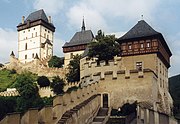
Karlštejn, the castle in Central Bohemia founded in 1348 by Charles IV.
Charles IV, eleventh king of Bohemia. Charles IV was elected the Greatest Czech of all time.[7]

Archaeologists have found evidence of prehistoric human settlement in the area dating back to the Neolithic era. In the classical era, from the 3rd century BC Celtic migrations, the Boii (see Bohemia) and later in the 1st century Germanic tribes of Marcomanni and Quadi settled there. During the Migration Period around the 5th century, many Germanic tribes moved westwards and southwards out of Central Europe. In an equally significant migration, Slavic people from the Black Sea and Carpathian regions settled in the area (a movement that was also stimulated by the onslaught of peoples from Siberia and Eastern Europe: Huns, Avars, Bulgars and Magyars). Following in the Germans' wake, they moved southwards into Bohemia, Moravia, and some of present day Austria. During the 7th century the Frankish merchant Samo, supporting the Slavs fighting their Avar rulers, became the ruler of the first known Slav state in Central Europe. The Moravian principality arose in the 8th century (see Great Moravia). The Bohemian or Czech state emerged in the late 9th century when it was unified by the Přemyslid dynasty. The kingdom of Bohemia was a significant regional power during the Middle Ages. It was part of the Holy Roman Empire during the entire existence of this confederation.[8]

In 1212 King Přemysl Otakar I (1198-1230), bearing the title “king“ already since 1198, extracted a Golden Bull of Sicily (a formal edict) from the emperor confirming the royal title for Otakar and his descendants. The 13th century was also a period of large-scale German immigration. The Germans populated towns and mining districts on the Bohemian periphery and in some cases formed German colonies in the interior of the Czech lands. In 1241 the mighty Mongol army launched an invasion into Europe, and after the Battle of Legnica the Mongols carried their devastating raid into Moravia.[9] The King Přemysl Otakar II (1253–1278), earned the nickname of “the King of Gold and Iron” due to his military power and wealth. He met his death at the Battle on the Marchfeld in 1278 in a war with his rival, the Roman king Rudolph I of Habsburg.[10] In 1306, the Přemyslid line had died out, and, after a series of dynastic wars, a new Luxemburg dynasty captured the Bohemian crown. The 14th century, particularly the reign of Charles IV (1342-1378), is considered the Golden Age of Czech history. Of particular significance was the founding of Charles University in Prague in 1348. The Black Death which had raged in Europe from 1347-1352 decimated the Kingdom of Bohemia in 1380.[11]
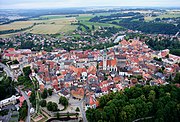
Tábor, town in South Bohemia founded in 1420 by Hussites

Religious conflicts such as the 15th century Hussite Wars and the 17th century Thirty Years' War had a devastating effect on the local population. From the 16th century, Bohemia came increasingly under Habsburg control as the Habsburgs became first the elected and then hereditary rulers of Bohemia. Czechs call the period from 1620 (the Battle of White Mountain) till the late 18th century, the "Dark Age". The population of the Czech lands declined by a third due to war, disease, famine and the expulsion of Protestant Czechs.[12] The Habsburgs banned all religions other than Catholicism.[13] Ottoman Turks and Tatars invaded Moravia in 1663, taking 12,000 slaves.[14]

The reigns of Maria Theresa (1740-80) and her son Joseph II (1780-90), Holy Roman Emperor and co-regent from 1765, were characterized by enlightened rule. In 1742, most of Silesia (then the possession of the Bohemian crown) was seized by King Frederick the Great of Prussia in the War of the Austrian Succession. After the fall of the Holy Roman Empire, Bohemia became part of Austrian Empire and later of Austria-Hungary. The Great Famine, which lasted from 1770 until 1771, killed 12% of Czech lands’ population, up to 500,000 inhabitants, and radicalized countrysides leading to peasant uprisings. Serfdom was not completely abolished until 1848. After the revolutions of 1848, Emperor Franz Joseph attempted to rule as an absolute monarch, keeping all the nationalities in check.

Czechoslovakia

Main article: History of Czechoslovakia

An estimated 150,000 Czech soldiers died in World War I.[15] Following the collapse of the Austro-Hungarian Empire after World War I, the independent republic of Czechoslovakia was created in 1918. This new country incorporated regions of Bohemia, Moravia, Silesia, Slovakia and Carpathian Ruthenia (known as Subcarpathian Rus at the time) with significant German, Hungarian, Polish and Ruthenian speaking minorities.[16] Although Czechoslovakia was a unitary state, it provided what were at the time rather extensive rights to its minorities. However, it did not grant its minorities any territorial political autonomy. The failure to do this resulted in discontent and strong support among some of the minorities for a break from Czechoslovakia. Adolf Hitler took advantage of this opportunity and, supported by Konrad Henlein's Sudeten German National Socialist Party, gained the largely German speaking Sudetenland through the 1938 Munich Agreement. Poland annexed Polish inhabited areas around Český Těšín. Hungary gained parts of Slovakia and Subcarpathian Rus as a result of the First Vienna Award in November 1938.

Český Krumlov

The remainders of Slovakia and Subcarpathian Rus gained greater autonomy, with the state renamed to "Czecho-Slovakia" (The Second Republic; see Occupation of Czechoslovakia). Slovakia seceded in March 1939 and allied itself with Hitler's coalition. The remaining Czech territory was occupied by Germany, which transformed it into the so-called Protectorate of Bohemia and Moravia. The Protectorate was proclaimed part of the Third Reich, and President and Prime Minister were subordinate to the Nazi Reichsprotektor ("imperial protector"). Subcarpathian Rus declared independence as the Republic of Carpatho-Ukraine on 15 March 1939 but was invaded by Hungary the same day and formally annexed on 16 March. Approximately 390,000 Czechoslovak citizens, including 83,000 Jews, were killed or executed, and hundreds of thousands of others were sent to prisons and concentration camps or used as forced labour. A Nazi concentration camp existed at Terezin to the north of Prague. There was Czech resistance to Nazi occupation both at home and abroad, most notably with the assassination of Nazi leader Reinhard Heydrich in a Prague suburb on May 27, 1942. The Czechoslovak government-in-exile and its army fighting against the Germans were acknowledged by the Allies (Czechoslovak troops fought in Great Britain, North Africa, Middle East and Soviet Union). The occupation ended on 9 May 1945 with the arrival of Soviet and American armies and the Prague uprising.

Tomáš Garrigue Masaryk, first president of Czechoslovakia.

In 1945-46 almost the entire German minority in Czechoslovakia, about 2.7 million people, were expelled to Germany and Austria. During this time, thousands of Germans were held in prisons and detention camps, or used as forced labour. In the summer of 1945 there were several massacres. The only Germans not expelled were some 250,000 who had been active in the resistance against the Nazis or were considered economically important, though many of these emigrated later. Following a Soviet-organised referendum, the Subcarpathian Rus never returned under Czechoslovak rule but became part of the Ukrainian SSR as the Zakarpattia Oblast in 1946.

Czechoslovakia uneasily tried to play the role of a "bridge" between the West and East. However the Communist Party of Czechoslovakia rapidly increased in popularity, with a general disillusionment with the West (due to the pre-war Munich Agreement) and a favourable popular attitude towards the Soviet Union (due to the Soviets' role in liberating Czechoslovakia from German rule). In the 1946 elections the Communists gained 38% of the votes and became the largest party in the Czechoslovak parliament. They formed a coalition government with other parties of the National Front, and moved quickly to consolidate power. The decisive step took place in February 1948. During a series of events characterized by Communists as a "revolution" and by anti-Communists as a "takeover", the Communist People's Militias secured control of key locations in Prague, and a new, all-Communist government was formed.

For the next 41 years, Czechoslovakia was a Communist state within the eastern bloc (see Czechoslovakia: 1948-1989). This period was marked by a variety of social developments. The Communist government completely nationalized the means of production and established a command economy. The economy grew rapidly during the 1950s and 1960s, but slowed down in the 1970s, with increasing problems during the 1980s. The political climate was highly repressive during the 1950s (including numerous show trials) but became more open and tolerant in the 1960s, culminating in Alexander Dubček's leadership in the 1968 Prague Spring that tried to create "socialism with a human face" and perhaps even introduce political pluralism. This was forcibly ended by the 21 August 1968 Warsaw Pact invasion.

The invasion was followed by a harsh program of "Normalization" in the late 1960s and the 1970s. Until 1989, the political establishment relied on censorship of the opposition, though using more "carrot" than "whip" to secure the populace's passivity. Dissidents published Charter 77 in 1977 and the first of a new wave of protests were seen in 1988.

Velvet revolution and the Czech Republic

In November 1989, Czechoslovakia returned to democracy through a peaceful "Velvet Revolution". However Slovak national aspirations strengthened, until on January 1, 1993 the country peacefully split into the independent Czech Republic and Slovakia. Both countries went through economic reforms and privatisations, with the intention of creating a market economy.

Voters embraced rapid economic reforms, and their success enabled the Czech Republic to become the first post-communist country to receive an investment-grade rating from international credit rating agencies. Most state-owned heavy industries were privatized through voucher privatization systems. The Czech Republic saw modest budget deficits, low unemployment, a positive balance of payments, a stable exchange rate, and a shift of exports from former communist economic bloc markets to Western Europe. The most important change since 1989 has been the return of the right to own property.

From 1991 the Czech Republic (originally as part of Czechoslovakia, and now in its own right) has been a member of the Visegrad Group and from 1995 of the OECD. The Czech Republic joined NATO on March 12, 1999 and the European Union on May 1, 2004.

Geography

General map of the Czech Republic
Rolling hills of Králický Sněžník.
Map of the Czech Republic showing cities and main towns
Šance Dam, part of the Moravian-Silesian Beskids
Main article: Geography of the Czech Republic
See also: Protected Areas of the Czech Republic

The Czech landscape is quite varied. Bohemia to the west consists of a basin drained by the Elbe (Czech: Labe) and the Vltava (or Moldau) rivers, and surrounded by mostly low mountains such as the Krkonoše range of the Sudetes. The highest point in the country, Sněžka, at 1,602 m (5,262 ft), is located here. Moravia, the eastern part of the country, is also quite hilly. It is drained mainly by the Morava River, but it also contains the source of the Oder (Czech: Odra) River. Water from the landlocked Czech Republic flows to three different seas: the North Sea, Baltic Sea and Black Sea. The Czech Republic also leases the Moldauhafen, a 30,000-square-metre (7.4-acre) lot in the middle of the Hamburg Docks, which was awarded to Czechoslovakia by Article 363 of the Treaty of Versailles to allow the landlocked country a place where goods transported down river could be transferred to seagoing ships. The territory reverts to Germany in 2028.

Phytogeographically, the Czech Republic belongs to the Central European province of the Circumboreal Region within the Boreal Kingdom. According to the WWF, the territory of the Czech Republic can be subdivided into four ecoregions: the Central European mixed forests, Pannonian mixed forests, Western European broadleaf forests and Carpathian montane conifer forests.

Weather and climate

The Czech Republic has a temperate continental climate with relatively hot summers and cold, cloudy winters, usually with snow. Most rain falls during the summer. The temperature difference between summers and winters is relatively high due to the landlocked geographical position.

Within the Czech Republic, temperatures vary greatly depending on the elevation. In general, at higher altitudes the temperatures decrease and precipitation increases. Another important factor is the distribution of the mountains. Therefore the climate is quite varied.

At the highest peak (Sněžka, 1,602 m/5,260 ft) the average temperature is only −0.4 °C (31 °F), whereas in the lowlands of South Moravia, the average temperature is as high as 10 °C (50 °F). The country's capital Prague has a similar average temperature, although this is influenced by urban factors.

The coldest month is usually January, followed by February and December. During these months there is usually snow in the mountains and sometimes in the major cities and lowlands. During March, April and May, the temperature usually increases rapidly, and especially during April the temperature and weather tends to vary widely during the day. Spring is also characterized by high water levels in the rivers due to melting snow, with occasional floods.

The warmest month of the year is July, followed by August and June. On average, summer temperatures are about 20 Celsius or 36 Fahrenheit degrees higher than during winter. Especially in the last decade,[citation needed] temperatures above 30 °C (86 °F) are not unusual. Summer is also characterized by rain and storms.

Autumn generally begins in September, which is still relatively warm, but much drier. During October, temperatures usually fall below 15° or 10°C (59° or 50°F) and deciduous trees begin to shed their leaves. By the end of November, temperatures usually range around the freezing point.

Population

Population of the Czech lands[17]
Year Total Change Year Total Change
1857 7,016,531 — 1930 10,674,386 6.6%
1869 7,617,230 8.6% 1950 8,896,133 -16.7%
1880 8,222,013 7.9% 1961 9,571,531 7.6%
1890 8,665,421 5.4% 1970 9,807,697 2.5%
1900 9,372,214 8.2% 1980 10,291,927 4.9%
1910 10,078,637 7.5% 1991 10,302,215 0.1%
1921 10,009,587 -0.7% 2001 10,230,060 -0.7%

The vast majority of the inhabitants of the Czech Republic are Czechs (94.2%). Minorities include the Slovaks (1.9%), Poles (0.5%), Vietnamese (0.44%), Germans (0.4%), and Gypsies.[18] According to the Interior Ministry of the Czech Republic, there were 431,215 foreigners legally residing in the country in October 2008, making up 4.1% of the population, with the largest groups being Ukrainians, Slovaks and Vietnamese.[19] The Czech Republic is home to between 250,000 and 300,000 Roma, who make up the country's second largest minority population after Slovaks.[20][21]

The fertility rate was low at 1.44 children born/woman. In 2007, immigration increased the population by almost 1%.

According to the Czech Statistics Office, 130,147 Ukrainians, 74,918 Slovaks, 58,877 Vietnamese, 26,606 Russians and 21,560 Poles lived in the Czech Republic in October 2008.[22] At present, there are almost 6,000 legally working Mongolians in the Czech Republic.[23]

Religion

The Czech Republic, along with Estonia, has one of the least religious populations in all of Europe. According to the 2001 census, 59% of the country is agnostic, atheist, a non-believer or a non-organized believer, 26.8% Roman Catholic and 2.5% Protestant.[24]

According to the most recent Eurobarometer Poll 2005,[25] 19% of Czech citizens responded that "they believe there is a God" (the second lowest rate among EU countries after Estonia with 16%),[26] whereas 50% answered that "they believe there is some sort of spirit or life force" and 30% that "they do not believe there is any sort of spirit, God, or life force".

Politics

Main article: Politics of the Czech Republic
Václav Havel, the first President of the Czech Republic.
Václav Klaus, current President of the Czech Republic.

Political system

The Czech Republic is a pluralist multi-party parliamentary representative democracy, with the Prime Minister as head of government. The Parliament (Parlament České republiky) is bicameral, with the Chamber of Deputies (Czech: Poslanecká sněmovna) (200 members) and the Senate (Senát)(81 members).

The President of the Czech Republic is elected by joint session of the parliament for a five-year term (no more than two consecutive terms). The president is a formal head of state with limited specific powers, most importantly to return bills to the parliament, nominate Constitutional Court judges for the Senate's approval, and dissolve the parliament under certain special and unusual circumstances. He also appoints the prime minister as well the other members of the cabinet on a proposal by the prime minister. Václav Klaus, now President of the Czech Republic, former Prime Minister and chairman of Civic Democrats (ODS), remains one of the country's most popular politicians.

The Prime Minister is the head of government and wields considerable powers, including the right to set the agenda for most foreign and domestic policy, mobilize the parliamentary majority, and choose government ministers.

The members of the Chamber of Deputies are elected for a four year term by proportional representation with a 5% election threshold. There are 14 voting districts identical to the country's administrative regions. The Chamber of Deputies, the successor to the Czech National Council, has the powers and responsibilities of the now defunct federal parliament of the former Czechoslovakia.

The members of the Senate are elected in single-seat constituencies by two-round runoff voting for a six-year term, with one-third elected every even year in the autumn. The first election was 1996 (for differing terms). This arrangement is modelled on the U.S. Senate, but each constituency is (roughly) the same size and the voting system used is a two-round runoff. The Senate is unpopular among the public and suffers from low election turnout (overall roughly 30% in the first round, 20% in the second).

Foreign policy

See also: Foreign relations of the Czech Republic

Membership in the European Union is central in Czech Republic's foreign policy, and the Czech Republic will take over the presidency of the European Union for the first half of 2009.

According to The Economist, the Czech Republic has earned "a reputation for promoting human rights at every turn". Czech officials have supported dissents everywhere from Burma to Belarus, Moldova and Cuba.[27]

Czech Republic is motivated by its experience of Nazi and communist oppression. Also, the country's first post-communist president Václav Havel is an ex-dissident writer, who has set a moral example and has attracted ex-dissidents to key government positions.[27] For example, every March since 2003, when Fidel Castro locked up 75 political opponents, activists have set up a cage in Wenceslas Square representing a Cuban prison cell. Frequent prison uniform-wearing protesters have included distinguished individuals such as the foreign minister, the mayor of Prague and musical stars.[27]

Czech Air Force Saab Gripen.

Some EU officials have been irritated by Czech Republic's activism in human rights. Czech Republic, and other countries emphasising human rights, have been in conflicts with EU countries who favour closer ties with dictatorships such as Cuba or Burma.[27]

Armed forces

Main article: Military of the Czech Republic

The Czech armed forces consist of the Army and Air Force and of specialized support units. In 2004, the Czech armed forces completely phased out conscription and transformed into a fully professional army and air force. The country has been a member of NATO since March 12, 1999. Defence spending is around 1.8% of GDP (2006).

Regions and districts

Main articles: Regions of the Czech Republic and Districts of the Czech Republic

Since 2000, the Czech Republic is divided into thirteen regions (Czech: kraje, singular kraj) and the capital city of Prague. Each region has its own elected Regional Assembly (krajské zastupitelstvo) and hejtman (usually translated as hetman or "president"). In Prague, their powers are executed by the city council and the mayor.

The older seventy-six districts (okresy, singular okres) including three 'statutory cities' (without Prague, which had special status) lost most of their importance in 1999 in an administrative reform; they remain as territorial divisions and seats of various branches of state administration.[28]

Map of the Czech Republic with regions.
Map with districts.
(Lic. plate) Region Capital Population (2004 est.) Population (2008 est.)
A Prague, the Capital City (Hlavní město Praha) 1,170,571 1,223,368
S Central Bohemian Region (Středočeský kraj) offices located in Prague (Praha) 1,144,071 1,214,356
C South Bohemian Region (Jihočeský kraj) České Budějovice 625,712 634,408
P Plzeň Region (Plzeňský kraj) Pilsen (Plzeň) 549,618 565,029
K Karlovy Vary Region (Karlovarský kraj) Karlovy Vary 304,588 308,450
U Ústí nad Labem Region (Ústecký kraj) Ústí nad Labem 822,133 835,260
L Liberec Region (Liberecký kraj) Liberec 427,563 435,755
H Hradec Králové Region (Královéhradecký kraj) Hradec Králové 547,296 553,503
E Pardubice Region (Pardubický kraj) Pardubice 505,285 513,949
M Olomouc Region (Olomoucký kraj) Olomouc 635,126 641,897
T Moravian-Silesian Region (Moravskoslezský kraj) Ostrava 1,257,554 1,250,066
B South Moravian Region (Jihomoravský kraj) Brno 1,123,201 1,143,389
Z Zlín Region (Zlínský kraj) Zlín 590,706 591,026
J Vysočina Region (Vysočina) Jihlava 517,153 514,470

Economy

Main article: Economy of the Czech Republic
Škoda Auto is the largest car manufacturer in Central Europe. In 2007, 630 032 cars were sold worldwide, the record in company's history.

The Czech Republic possesses a developed,[29] high-income[30] economy with a GDP per capita of 82% of the European Union average. One of the most stable and prosperous of the post-Communist states, the Czech Republic has seen a growth of over 6% annually in the last three years. Recent growth has been led by exports to the European Union, especially Germany, and foreign investment, while domestic demand is reviving.

Most of the economy has been privatized, including banks and telecommunications. The current right-center government plans to continue with privatization, including the energy industry and the Prague airport. It has recently agreed to the sale of a 7% stake of the energy producer ČEZ, with the sale of the Budějovický Budvar brewery also mooted.

Since 2004 the Czech Republic is a member state of the European Union and part of its single market.

The country has fully implemented the Schengen Agreement and therefore has abolished border controls, completely opening its borders with all of its neighbours (Germany, Austria, Poland, Slovakia) on December 21, 2007.[31] The Czech Republic is a member of the WTO.

The last Czech government had expressed a desire to adopt the euro in 2010, but the current government has postponed it due to budget deficits. An exact date has not been set up, but the Finance Ministry described adoption by 2012 as realistic[32] if public finance reform passes. However, the most recent draft of the euro adoption plan omits giving any date.

There are several challenges. The rate of corruption remains one of the highest among the other developed OECD countries. The public budgets remain in deficit despite strong growth of the economy in recent years. However, the 2007 deficit has been 1.58% GDP (according to EU accounting rules), far less than originally expected.

The Programme for International Student Assessment, coordinated by the OECD, currently ranks the Czech education as the 15th best in the world, being higher than the OECD average.[33]

Infrastructure

See also: Transport in the Czech Republic
New commuter trains called CityElefant made by Škoda Works operate near larger cities

Prague Airport is the main international airport in the country. In 2007, it handled 12.4 million passengers which makes it one of the busiest airports in Central Europe. In total, Czech Republic has 46 airports with paved runways, out of which six are for international air service.

České dráhy is the main railway operator in The Czech Republic with about 180 million passengers carried yearly. Its cargo division, ČD Cargo, is the fifth largest railway cargo operator in the European Union.

In 2005, according to the Czech Statistical Office, 65.4% of electricity was produced in steam, combined, and combustion power plants (mostly coal); 30% in nuclear plants; and 4.6% from renewable sources, including hydropower. Russia (via pipelines through Ukraine) and, to a lesser extent, Norway (via pipelines through Germany) supply the Czech Republic with liquid and natural gas.

The Czech Republic is reducing its dependence on highly polluting low-grade brown coal as a source of energy.. Nuclear energy presently provides about 30% of total power needs, and its share is projected to increase to 40%. Natural gas is procured from Russian Gazprom (roughly three-fourths of domestic consumption) and from Norwegian companies (most of the remaining one-fourth). Russian gas is imported via Ukraine (Friendship pipeline), Norwegian gas is transported through Germany. The gas consumption (approx. 100 TWh in 2003-5) is almost two times higher than the electricity consumption. South Moravia has small oil and gas deposits.

Internet

See also: Internet in the Czech Republic

The Czech Republic has the most Wi-Fi subscribers in the European Union.[34][35] By the beginning of 2008 there was over 800 mostly local WISPs[36][37] with about 350 000 subscribers in 2007. Mobile internet is quite popular. Plans based on either GPRS, EDGE, UMTS or CDMA2000 are being offered by all three mobile phone operators (T-Mobile, Vodafone, Telefonica O2) and U:fon. Government-owned Český Telecom slowed down broadband penetration. At the beginning of 2004, local loop unbundling began, and alternative operators started to offer ADSL (and also SDSL). This, and later privatisation of Český Telecom helped drive down prices. On July 1, 2006, Český Telecom was renamed to Telefónica O2 Czech Republic. As of January 2006, ADSL2+ is offered in many variants, both with data limit and without with speeds up to 10 Mbit/s. Cable internet is gaining popularity with its higher download speeds beginning at 2 Mbit/s up to 20 Mbit/s. The biggest ISP, UPC (which has bought another CATV internet provider Karneval in 2007) is providing its service in big cities (Prague, Brno, Ostrava)

Tourism
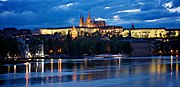
After the fall of Iron Curtain in 1989, Prague has become one of the most visited cities in Europe.
Main article: Tourism in the Czech Republic

The Czech economy gets a substantial income from tourism: in 2001, the total earnings from tourism reached 118.13 billion CZK, making up 5.5% of GNP and 9.3% of overall export earnings. The industry employs more than 110,000 people - over 1% of the population.[38]

There are several centres of tourist activity: The historic city of Prague is the primary tourist attraction, and the city is also the most common point of entry for tourists visiting other parts of the country.[39] Most other cities in the country attract significant numbers of tourists, but the spa towns such as Karlovy Vary, Mariánské Lázně and Františkovy Lázně are particularly popular holiday destinations. Other popular tourist sites are the many castles and chateaux, such as those at Karlštejn, Konopiště and Český Krumlov. Away from the towns, areas as Český ráj, Šumava and the Krkonoše Mountains attract visitors seeking outdoor pursuits.

The country is also famous for its love of puppetry and marionettes. The Pilsner style beer originated in western Bohemian city of Plzeň.

Cuisine

See also: Czech cuisine
Vepřo-knedlo-zelo (Roast pork with dumplings and cabbage)

Czech cuisine is marked by a strong emphasis on meat dishes. Pork is quite common, and beef and chicken are also popular. Goose, duck, rabbit and wild game are served. Fish is rare, with the occasional exception of fresh trout, and carp, which is served at Christmas.

Aside from Slivovitz, Czech beer and wine, Czechs also produce two uniquely Czech liquors, Fernet Stock and Becherovka. Kofola is a non-alcoholic Czech soft drink somewhat similar in look and taste to Coca-Cola, which is also popular.

Sport

Main article: Sport in the Czech Republic
See also: Czech Republic national football team

Sport plays a significant part in the life of many Czechs who are generally loyal supporters of their favourite teams or individuals. The two leading sports in the Czech Republic are football and ice hockey, both drawing the largest attention of both the media and supporters. The many other sports with professional leagues and structures include basketball, volleyball, handball, athletics, floorball and others. Sport is a source of strong waves of patriotism, usually rising several days or weeks before an event and sinking several days after. The events considered the most important by Czech fans are: the Ice Hockey World Championship, Olympic Ice hockey tournament, the Euro, the football World Cup and qualification matches for such events. In general, any international match of the Czech ice hockey or football national team draws attention, especially when played against a traditional rival: Germany in football; Russia, Sweden and Canada in ice hockey; and Slovakia in both.

Music

See also: Music of the Czech Republic

Music in the Czech Republic has roots both in high-culture opera and symphony and in the traditional music of Bohemia and Moravia. Cross-pollination and diversity are important aspects of Czech music: Composers were often influenced by traditional music; jazz and bluegrass music have become popular; pop music often consisted of English language hits sung in Czech. The most important Czech composers are Antonín Dvořák and Bedřich Smetana.

Literature

Jaroslav Hašek, author of The Good Soldier Švejk
See also: Czech literature

Czech literature is the literature of the historical regions of Bohemia, Moravia, and the Czech-speaking part of Silesia, (now part of the Czech Republic, formerly of Czechoslovakia). This most often means literature written by Czechs, in the Czech language, although Old Church Slavonic, Latin, and German were also used, mostly in the early periods. Modern authors from the Czech territory who wrote in other languages (e.g. German) are generally considered separately, and their writing usually existed in parallel with Czech-language literature and did not interact with it. Thus Franz Kafka, for example, who wrote in German (though he also knew Czech rather well), falls within Austrian literature, though he lived his entire life in Bohemia.

Czech literature is divided into several main time periods: the Middle Ages; the Hussite period; the years of re-Catholicization and the baroque; the Enlightenment and Czech reawakening in the 19th century; the avantgarde of the interwar period; the years under Communism and the Prague Spring; and the literature of the post-Communist Czech Republic. Czech literature and culture played a major role on at least two occasions when Czech society lived under oppression and no political activity was possible. On both of these occasions, in the early 19th century and then again in the 1960s, the Czechs used their cultural and literary effort to create political freedom and to establish a confident, politically aware nation.

International rankings

  • Human Development Index 2007: Rank 32nd out of 178 countries
  • Index of Economic Freedom 2007: Rank 31st out of 157 countries
  • Reporters Without Borders worldwide press freedom index 2007: Rank 14th out of 169 countries
  • Global Competitiveness Report 2006: Rank 29th out of 125 countries
  • Democracy Index (January 2007): Ranks 18th of 167 countries (the highest rank of functioning democracy along with only 27 others)
  • It was also ranked as the highest alcohol-consuming nation by The Economist in 2006.

Cyprus

Cyprus

Republic of Cyprus
Κυπριακή Δημοκρατία (Greek)
Kypriakī́ Dīmokratía
Kıbrıs Cumhuriyeti (Turkish)
Flag of Cyprus Coat of arms of Cyprus
Flag Coat of arms
Anthem: Υμνος είς την Ελευθερίαν
Ýmnos eis tīn Eleutherían
Hymn to Liberty1
Location of Cyprus
Location of Cyprus (dark green)

– on the European continent (light green & dark grey)
– in the European Union (light green)

Capital
(and largest city)
Nicosia (Lefkosia, Lefkoşa)
35°08′N 33°28′E / 35.133, 33.467
Official languages Greek, Turkish
Demonym Cypriot
Government Presidential republic
- President Dimitris Christofias
Independence from the United Kingdom
- Date 16 August 1960[1]
- Independence Day 1 October[2]
EU accession 1 May 2004
Area
- Total 9,251 km2 (167th)
3,572 sq mi
- Water (%) negligible
Population
- 1.1.2008 census 794,600
- Density 85/km2 (85th)
221/sq mi
GDP (PPP) 2007 IMF estimate
- Total $21.400 billion[3] (108th)
- Per capita $27,171[3] (31st)
GDP (nominal) 2007 IMF estimate
- Total $21.303 billion[3] (88th)
- Per capita $27,047[3] (29th)
Gini (2005) 29 (low) (19th)
HDI (2007) ▲ 0.903 (high) (28th)
Currency Euro2 (EUR)
Time zone EET (UTC+2)
- Summer (DST) EEST (UTC+3)
Drives on the left
Internet TLD .cy3
Calling code 357
1 Also the national anthem of Greece.
2 Before 2008, the Cypriot pound.
3 The .eu domain is also used, shared with other European Union member states.

Cyprus (Greek: Κύπρος, transliterated: Kýpros, IPA: [ˈcipɾo̞s]; Turkish: Kıbrıs), officially the Republic of Cyprus (Greek: Κυπριακή Δημοκρατία, Kypriakī́ Dīmokratía, [cipɾiaˈci ðimo̞kɾaˈtia]; Turkish: Kıbrıs Cumhuriyeti), is an island country situated in the eastern Mediterranean east of Greece, west of Lebanon, Syria, and Israel, south of Turkey and north of Egypt.

Cyprus is the third largest Mediterranean island and one of the most popular tourist destinations, attracting over 2.4 million tourists per year.[4] A former British colony, it became an independent republic in 1960[1] and a member of the Commonwealth in 1961. The Republic of Cyprus is one of the advanced economies in the region,[5] and has been a member of the European Union since 1 May 2004. It adopted the euro on 1 January 2008.

In 1974, following years of intercommunal violence between ethnic Greeks and Turks and an attempted coup d'état by Greek Cypriot nationalists aimed at annexing the island to Greece and engineered by the military junta then in power in Athens,[6] Turkey invaded and occupied one third of the island. This led to the displacement of thousands of Cypriots and the establishment of a separate Turkish Cypriot political entity in the north. This event and its resulting political situation are matters of ongoing dispute.

The Republic of Cyprus, the internationally recognised state, has de jure sovereignty over the entire island of Cyprus and its surrounding waters except the 3% which appendix O of the Treaty of Establishment of the Republic allocates to the United Kingdom as sovereign military bases. The island is de facto partitioned into four main parts:[7]

  • the area under the effective control of the Republic of Cyprus, in the south of the island;
  • the Turkish-controlled area in the north,[8] calling itself the Turkish Republic of Northern Cyprus (recognised only by Turkey);
  • the United Nations-controlled Green Line, separating the two; and
  • two British Sovereign Base Areas (Akrotiri and Dhekelia).[9]

Contents

1 Etymology
  • 2 Geography
  • 3 History
  • 4 Government
    • 4.1 Districts
    • 4.2 Exclaves and enclaves
    • 4.3 Human rights
  • 5 Military
  • 6 Economy
  • 7 Demographics
    • 7.1 Religion
    • 7.2 Education
  • 8 Culture
    • 8.1 Film
    • 8.2 Art
    • 8.3 Music
    • 8.4 Literature
    • 8.5 Cuisine
    • 8.6 Sports
    • 8.7 Media
  • 9 Infrastructure
    • 9.1 Transportation
    • 9.2 Health care
    • 9.3 Telecommunications
  • 10 International membership
  • 11 International rankings
  • 12 See also
  • 13 References
  • 14 Further reading
  • 15 External links

Etymology

The name Cyprus has a somewhat uncertain etymology. One suggestion is that it comes from the Greek word for the Mediterranean cypress tree (Cupressus sempervirens), κυπάρισσος (kypárissos), or even from the Greek name of the henna plant (Lawsonia alba), κύπρος (kýpros). Another school suggests that it stems from the Eteocypriot word for copper. Georges Dossin, for example, suggests that it has roots in the Sumerian word for copper (zubar) or for bronze (kubar), from the large deposits of copper ore found on the island. Through overseas trade the island has given its name to the Classical Latin word for the metal through the phrase aes Cyprium, "metal of Cyprus", later shortened to Cuprum.[10] Cyprus is also called "the island of Aphrodite",[11] since in Greek mythology, the goddess Aphrodite, of beauty and love, was born in Cyprus.

Geography

Main article: Geography of Cyprus

History

Main article: History of Cyprus

Temple to Apollon Ilatis outside the city of Limassol.
Salamis, Cyprus, outside the city of Amochostos.

Cyprus is the mythical birthplace of Aphrodite, Adonis and home to King Cinyras, Teucer and Pygmalion.[12] The earliest confirmed site of human activity is Aetokremnos, situated on the south coast, indicating that hunter-gatherers were active on the island from around 10,000 BC, with settled, village communities dating from 8200 BC. Important remains from this early Neolithic period can be found at Shillourokambos, Kastros, and Khirokitia, where decorated pottery and figurines of stone quite distinct from the cultures of the surrounding mainland survive. The Mycenaean Greeks first reached Cyprus around 1600 BC, with settlements dating from this period scattered all over the island. Another wave of Greek settlement is believed to have taken place in the period 1100-1050 BC, with the island's predominantly Greek character dating from this period. Several Phoenician colonies were founded in the 8th century BC, like Kart-Hadasht ('New Town'), near present day Larnaca and Salamis

Cyprus was conquered by Assyria in 709 BC, before a brief spell under Egyptian rule and eventually Persian rule in 545 BC. Cypriots, led by Onesilos, joined their fellow-Greeks in the Ionian cities during the unsuccessful Ionian Revolt in 499 BC against the Achaemenid Empire. The island was brought under permanent Greek rule by Alexander the Great and the Ptolemies of Egypt following his death. Full Hellenisation took place during the Ptolemaic period, which ended when Cyprus was annexed by the Roman Republic in 58 BC. Cyprus was one of the first stops in apostle Paul's missionary journey. In 395 AD it became part of the Byzantine Empire,[13] which lost it temporarily to the Arabs in 643 AD before reclaiming it in 966 AD.

Kourion Theatre outside the city of Limassol.
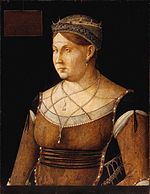
Caterina Cornaro, Queen of Cyprus.

Richard I of England captured the island in 1191 during the Third Crusade, using it as a major supply base that was relatively safe from the Saracens. A year later Guy of Lusignan purchased the island from the Templars to compensate the loss of his kingdom.

The Republic of Venice seized control of the island in 1489 after the abdication of Queen Caterina Cornaro, the widow of James II, the last Lusignan king of Cyprus. Using it as an important commercial hub, Venetians soon fortified Nicosia, the capital and most important city, with its famous Venetian Walls. Throughout Venetian rule, the Ottoman Empire frequently raided Cyprus. In 1539 the Ottomans destroyed Limassol. Fearing the worst, the Venetians fortified Famagusta, Nicosia, and Kyrenia.

In 1570, a full scale conquest under Piyale Pasha with 60,000 troops brought the island under Ottoman control, despite stiff resistance by the inhabitants of Nicosia and Famagusta. 20,000 Nicosians were put to death, and every church, public building, and palace was looted.[14] The Ottomans applied the millet system and allowed religious authorities to govern their own non-Muslim minorities, but at the same time invested the Orthodox Church as a mediator between Christian Cypriots and the authorities granting it not only religious but political and economic powers. Heavy taxation led to rebellions - between 1572 and 1668, around twenty-eight bloody uprisings took place - forcing the Sultan to intervene. The first large-scale census of the Ottoman Empire in 1831, counting only men, showed 14,983 Muslims and 29,190 Christians.[15] By 1872, the population of the island had risen to 144,000 comprising 44,000 Muslims and 100,000 Christians.[16]

Administration (but not sovereignty) of the island was ceded to the British Empire in 1878, in the aftermath of the Russo-Turkish War (1877–1878). The island would serve Britain as a key military base in its colonial routes. By 1906, when the Famagusta harbour was completed, Cyprus was a strategic naval outpost overlooking the Suez Canal, the crucial main route to India, then Britain's most important colony. Following World War I and the Ottoman alliance with the Central powers, the United Kingdom annexed the island. In 1923, under the Treaty of Lausanne, the nascent Turkish republic relinquished any claim to Cyprus, and in 1925 it was declared a British Crown Colony. Many Greek Cypriots fought in the British Army during both world wars, under the impression that Cyprus would eventually be united with Greece.

In January 1950 the Orthodox Church organised a referendum boycotted by the Turkish Cypriot community with over 90% voting in favour of "enosis" (union with Greece). Restricted autonomy under a constitution was proposed by the British administration but eventually rejected. In 1955 the EOKA organisation was founded, seeking independence and union with Greece through armed struggle. At the same time the TMT, calling for Taksim, was established by the Turkish Cypriots as a counterweight.[17] Turmoil on the island was met with force by the British who started openly favouring Turks in police and administration as part of a divide-and-conquer policy.

In 1960 Cyprus attained independence after an agreement in Zürich and London between the United Kingdom, Greece and Turkey. Britain retained two Sovereign Base Areas in Akrotiri and Dhekelia while government posts and public offices were allocated by ethnic quotas giving the minority Turks a permanent veto, 30% in parliament and administration, and granting the 3 mother-states guarantor rights.

In 1963 inter-communal violence broke out, partially sponsored by both "motherlands"[18] - with Turkish Cypriots in some areas withdrawing into enclaves and Greek Cypriot leader Archbishop Makarios III calling for constitutional changes as a means to ease tensions. The United Nations was involved, and the United Nations forces in Cyprus (UNICYP) deployed at flash points.

The Greek military government in power in Greece in the early 1970s became dissatisfied with the policy of Makarios in Cyprus, and the lack of progress towards Enosis. Partly for this reason, and partly as a distraction from domestic opposition, in 1974 the junta organised a coup on 13 July. Nikos Sampson was declared president and declared union with Greece. The Turkish government protested, and unsuccessfully sought British intervention. Seven days later, Turkey invaded Cyprus, claiming a right under the Zurich and London agreements to intervene in order to restore constitutional order. The Greeks announced the formation of a new EOKA paramilitary group to resist the invaders, but this proved counter-productive, hastening the expulsions of Greeks from Turkish-held areas. Heavily outnumbered, the Greek forces were unable to resist the Turkish onslaught. The Ayia Napa area was only saved from occupation because it lay behind the British Sovereign Base area, which the Turks were anxious not to invade. International pressure led to a ceasefire. The result was that 37% of the land fell within the Turkish occupation zone. 170,000 Greek Cypriots were evicted from their homes in the north, with 50,000 Turkish Cypriots following the opposite path.

In 1983 Turkish Cypriots unilaterally proclaimed independence, which was only recognised by Turkey.

As of today, there are 1,534 Greek Cypriots[19] and 502 Turkish Cypriots[20] missing as a result of the invasion. The events of the summer of 1974 dominate the politics on the island, as well as Greco-Turkish relations. Around 100,000 settlers from Turkey are believed to be living in the north in violation of the Geneva Convention and various UN resolutions. Following the invasion and the capture of its northern territory by Turkish troops, the Republic of Cyprus announced that all of its ports of entry in the north are closed, as they are not under its effective control. Turkey refers to this event as an "embargo".

Since de facto, though not de jure, partition of the Republic, the north and south have followed separate paths. The Republic of Cyprus is a constitutional democracy that has reached great levels of prosperity, with a booming economy and good infrastructure. It is part of the UN, the European Union and several other organisations by whom it is recognised as the sole legitimate government of the whole island. The area of the Republic of Cyprus not under its effective control, the north, is over-dependent on help from Turkey. The last major effort to settle the Cyprus dispute, was the Annan Plan. On 10 March 2003, this most recent phase of talks collapsed in The Hague, Netherlands, when 30 year strong Turkish Cypriot leader Denktaş told the Secretary-General he would not put the Annan Plan to referendum. "The plan was unacceptable for us. This was not a plan we would ask our people to vote for," Mr Denktaş said. The UN plan had undergone several revisions in an attempt to win support. It was the Turkish Cypriot side which refused to even talk further, and which was blamed for the failure of the peace process.[21] Later in its 5th[22] revision the plan gained the support of the Turkish Cypriots but lost support of the Greek Cypriots.

In July 2006 the island served as a safe haven for people fleeing Lebanon due to the conflict between Israel and Hezbollah.[23]

In March 2008, the Republic of Cyprus demolished a wall that for decades had stood at the boundary between the Greek Cypriot controlled side and the UN buffer zone.[24] The wall had cut across Ledra Street in the heart of Nicosia and was seen as a strong symbol of the island's 32-year division. On 3 April 2008, Ledra Street was reopened in the presence of Greek and Turkish Cypriot officials.[25]

Government

Main articles: Politics of Cyprus and Foreign relations of Cyprus
The Presidential Palace (Residence) in Nicosia.

Cyprus is a Presidential republic. The head of state and the government is the President, who is elected by the universal suffrage for a five-year term. Executive power is exercised by the government. Federal legislative power is vested in both the government and the House of Representatives. The Judiciary is independent of the executive and the legislature.

The 1960 Constitution provided for a presidential system of government with independent executive, legislative, and judicial branches, as well as a complex system of checks and balances, including a weighted power-sharing ratio designed to protect the interests of the Turkish Cypriots. The executive, was headed by a Greek Cypriot president and a Turkish Cypriot vice president elected by their respective communities for five-year terms and each possessing a right of veto over certain types of legislation and executive decisions. Legislative power rested on the House of Representatives, also elected on the basis of separate voters' rolls. Since 1964, following clashes between the two communities, the Turkish Cypriot seats in the House remain vacant.

After an invasion of the island by Turkey in 1974, Cyprus was divided, de facto, into the Greek Cypriot controlled southern two-thirds of the island and the Turkish-occupied northern third. The Turkish Cypriots subsequently declared independence in 1983 as the Turkish Republic of Northern Cyprus but have not been recognised by any country in the world, except Turkey. In 1985, the TRNC adopted a constitution and held its first elections. All foreign governments (except Turkey), as well as the United Nations, recognise the sovereignty of the Republic of Cyprus over the whole island of Cyprus.

The House of Representatives currently has 59 members elected for a five year term, 56 members by proportional representation and 3 observer members representing the Maronite, Latin and Armenian minorities. 24 seats are allocated to the Turkish community but remain vacant since 1964. The political environment is dominated by the communist AKEL, the liberal conservative Democratic Rally, the centrist[26] Democratic Party, the social-democratic EDEK and the centrist EURO.KO.

On 17 February 2008, Dimitris Christofias of the AKEL was elected President of Cyprus, thus marking his party's first electoral victory without being part of a wider coalition, making Cyprus one of only three countries in the world to have currently a democratically elected communist government (the others being Moldova and Nepal) and the only European Union member state currently under communist leadership. Christofias took over government from Tassos Papadopoulos of Democratic Party, who had been in office since February 2003.

Districts

Main articles: Districts of Cyprus and List of cities, towns and villages in Cyprus

The Republic of Cyprus is divided into six districts:[27] Nicosia, Famagusta, Kyrenia, Larnaca, Limassol and Paphos.

Map of Cyprus Districts Greek name Turkish name
NicosiaLarnacaLimassolPaphosAkrotiriKyreniaFamagustaDhekelia
About this image
Famagusta Αμμόχωστος (Ammochostos) Gazimağusa
Kyrenia Κερύvεια (Keryneia) Girne
Larnaca Λάρνακα (Larnaka) Larnaka/İskele
Limassol Λεμεσός (Lemesos) Limasol/Leymosun
Nicosia Λευκωσία (Lefkosia) Lefkoşa
Paphos Πάφος (Pafos) Baf

Exclaves and enclaves

Pyrgos (Cyprus)

Cyprus has four exclaves, all in territory that belongs to the British Sovereign Base Area of Dhekelia. The first two are the villages of Ormidhia and Xylotymvou. Additionally there is the Dhekelia Power Station, which is divided by a British road into two parts. The northern part is an enclave, like the two villages, whereas the southern part is located by the sea and therefore not an enclave, although it has no territorial waters of its own.[28]

The UN buffer zone separating the territory controlled by the Turkish Cypriot administration from the rest of Cyprus runs up against Dhekelia and picks up again from its east side, off Ayios Nikolaos (connected to the rest of Dhekelia by a thin land corridor). In that sense, the buffer zone turns the southeast corner of the island, the Paralimni area, into a de facto, though not de jure, exclave.

Human rights

The constant focus on the division of the island can sometimes mask other human rights issues. Prostitution is rife in both the government-controlled and the Turkish-occupied regions, and the island as a whole has been criticised[29] for its role in the sex trade as one of the main routes of human trafficking from Eastern Europe.[30] The regime in the North has been the focus of occasional freedom of speech criticisms[31] regarding heavy-handed treatment of newspaper editors. Domestic violence legislation in the Republic remains largely unimplemented,[32] and it has not yet been passed into law in the North. Reports on the mistreatment of domestic staff, mostly immigrant workers from developing countries, are sometimes reported in the Greek Cypriot press.[33]

Military

Main article: Military of Cyprus

The Cypriot National Guard is the main military institution of the Republic of Cyprus. It is a combined arms force, with land, air and naval elements.

The land forces of the Cypriot National Guard comprise the following units:

  • First Infantry Division (Ιη Μεραρχία ΠΖ)
  • Second Infantry Division (ΙΙα Μεραρχία ΠΖ)
  • Fourth Infantry Brigade (ΙVη Ταξιαρχία ΠΖ)
  • Twentieth Armored Brigade (ΧΧη ΤΘ Ταξιαρχία)
  • Third Support Brigade (ΙΙΙη Ταξιαρχία ΥΠ)
  • Eighth Support Brigade (VIIIη Ταξιαρχία ΥΠ)

The air force includes the 449th Helicopter Gunship Squadron (449 ΜΑΕ) - operating SA-342L and Bell 206 and the 450th Helicopter Gunship Squadron (450 ME/P) - operating Mi-35P, BN-2B and PC-9. Current Senior officers include Supreme Commander, Cypriot National Guard: Lt. Gen. Konstantinos Bisbikas, Deputy Commander, Cypriot National Guard: Lt. Gen. Savvas Argyrou and Chief of Staff, Cypriot National Guard: Maj. Gen. Gregory Stamoulis.

Economy

Main article: Economy of Cyprus

The Cypriot economy is prosperous and has diversified in recent years.[34] According to the latest IMF estimates, its per capita GDP (adjusted for purchasing power) is, at $28,381, just above the average of the European Union.[35]Cyprus has been sought as a base for several offshore businesses for its highly developed infrastructure. Economic policy of the Cyprus government has focused on meeting the criteria for admission to the European Union. Adoption of the euro as a national currency is required of all new countries joining the European Union, and the Cypriot government adopted the currency on 1 January 2008.[34]

Cyprus is a member state of the European Union and the Eurozone.

Oil has recently been discovered in the seabed between Cyprus and Egypt, and talks are underway between Lebanon and Egypt to reach an agreement regarding the exploration of these resources.[36] The seabed separating Lebanon and Cyprus is believed to hold significant quantities of crude oil and natural gas.[36]

The economy of the Turkish-occupied area is dominated by the services sector, including the public sector, trade, tourism and education, with smaller agriculture and light manufacturing sectors. The economy operates on a free-market basis, although it continues to be handicapped by the political isolation of Turkish Cypriots, the lack of private and governmental investment, high freight costs, and shortages of skilled labor. Despite these constraints, the economy turned in an impressive performance in 2003 and 2004, with growth rates of 9.6% and 11.4%. The average income in the area is $5,000 per capita, and the Turkish government has pledged to increase this to $12,000 through investment and aid.[37] Growth has been buoyed by the relative stability of the Turkish new lira and by a boom in the education and construction sectors.

The island has witnessed a massive growth in tourism over the years and as such the property rental market in Cyprus has grown along side. Added to this is the capital growth in property that has been created from the demand of incoming investors and property buyers to the island. [38]

Demographics

Main article: Demographics of Cyprus
Population Growth.
Population structure.

According to the last census carried out by the Republic in 1960, Greek Cypriots comprise 77% of the island's population, Turkish Cypriots 18%, while the remaining 5% are of other ethnicities. However, after the Turkish invasion of 1974, the demography of the island changed considerably due to the economic prosperity in the areas of Cyprus still under the control of the Republic of Cyprus in contrast to the international isolation and economic downturn experienced the areas under the control of Turkish troops. In the latest census in 2006, the percentage of Greek Cypriots remained steadily at 76% (660,000) while the population of Turkish Cypriots dropped to 10% (89,000) as many emigrated to western countries. The main reason of the mass migration was due to the intercommunal violence until 1974 and the economic downturn of Northern Cyprus due to the economic isolation. In addition about 150,000 Turks from Anatolia were transferred or decided to settle in the north changing the actual demographic structure of the island. Northern Cyprus now claims 265,100 inhabitants,[39] closer to 30% of the population of the island. The TRNC has granted citizenship to these immigrants: however, as the TRNC is not recognised by the Republic or the international community (with the exception of Turkey), its power to create new citizens is not recognised and the newcomers retain Turkish passports. The result of this situation is that percentage population estimates vary widely.

Furthermore Cyprus has also seen a large influx of guest workers from countries such as Thailand, the Philippines, and Sri Lanka, as well as major increases in the numbers of permanent Russian, British or other EU residents. Since the country joined the European Union, a significant Polish population has also sprung up, joining sizeable communities from Russia and Ukraine (mostly Pontic Greeks, immigrating after the fall of the Eastern Bloc), Bulgaria, Romania, and Eastern European states. By 2006, about 120,000 immigrants settled in Cyprus, the three largest groups being 37,000 Greeks, 26,000 Britons, and 10,000 Russians. The island is also home to a significant Armenian minority which numbers around 2,000 individuals as well as a large refugee population consisting of people mainly from Serbia, Palestine, and Lebanon. There is also a Kurdish minority present in Cyprus.

There is also a significant and thriving Cypriot Diaspora in other countries, within the United States, the United Kingdom, Greece, and Australia hosting the majority of migrants who fled the Turkish invasion in 1974. Specifically in the United Kingdom it is estimated that there are 150,000 Cypriots.

Religion

Main article: Religion in Cyprus
Agios Lazaros Church in Larnaca.

Most Greek Cypriots are members of the Greek Orthodox Church, whereas most Turkish Cypriots are Muslim. According to Eurobarometer 2005,[40] Cyprus is one of the most religious countries in the European Union, along with Malta, Romania, Greece and Poland. In addition to the Orthodox Christian and Muslim communities, there are also small Bahá'í, Jewish, Protestant (including Pentecostal), Roman Catholic, Maronite (Eastern Rites Catholic) and Armenian Apostolic communities in Cyprus.

Education

For a complete list see List of colleges and universities in Cyprus

Cyprus has a highly developed system of primary and secondary education offering both public and private education. The high quality of instruction can be attributed to a large extent to the above-average competence of the teachers but also to the fact that nearly 7% of the GDP is spent on education which makes Cyprus one of the top three spenders of education in the EU along with Denmark and Sweden. State schools are generally seen as equivalent in quality of education to private-sector institutions. However, the value of a state high-school diploma is limited by the fact that the grades obtained account for only around 25% of the final grade for each topic, with the remaining 75% assigned by the teacher during the semester, in a minimally transparent way. Greek (List of universities in Greece) and Cypriot universities ignore high school grades almost entirely for admissions purposes. While a high-school diploma is mandatory for university attendance, admissions are decided almost exclusively on the basis of scores at centrally administered university entrance examinations that all university candidates are required to take. The majority of Cypriots receive their higher education at Greek, British, Turkish, other European and North American universities. It is noteworthy that Cyprus currently has the highest percentage of citizens of working age who have higher-level education in the EU at 30% which is ahead of Finland's 29.5%.

Private colleges and state-supported universities have been developed.

  • University of Cyprus: Established in 1989
  • Cyprus University of Technology: Started in 2007
  • European University - Cyprus: Established in 1961 as Cyprus College and changed its name in 2007
  • University of Nicosia: Established in 1981 and formerly known as Intercollege; It changed to its present name in 2007. There are a total of 5,000 students at the Nicosia, Limassol and Larnaca campuses
  • Frederick University

Students from overseas are also increasing.

Universities in the north side of Cyprus :

Eastern Mediterranean University, Famagusta

Near East University, Nicosia (North)

Girne American University, Girne

European University of Lefke, Lefke

Cyprus International University, Nicosia (North)

Middle East Technical University, North Cyprus Campus, Guzelyurt

Art

Notable artists include Rhea Bailey, Mihail Kkasialos, Theodoulos Gregoriou, Helene Black, George Skoteinos,Kalopedis family, Nicos Nicolaides, Stass Paraskos, Arestís Stasí, Telemachos Kanthos, Adamantios Diamantis and Konstantia Sofokleous.

Music

Main article: Music of Cyprus

The traditional folk music of Cyprus has many common elements with Greek mainland and island folk music, including dances like the sousta, syrtos, zeibekikos, tatsia, and the kartsilamas. The instruments commonly associated with Cyprus folk music are the violin ["fkiolin"], the lute ["laouto"], the accordion, and the Cyprus flute "pithkiavlin". There is also a form of musical poetry known as "chattista", which is often performed at traditional feasts and celebrations. Composers associated with traditional music in Cyprus include Evagoras Karageorgis, Marios Tokas, Solon Michaelides, Savvas Salides. Pop music in Cyprus is generally influenced by the Greek pop music "Laïka" scene, with several artists such as Anna Vissi and Evridiki earning widespread popularity. Cypriot rock and "Éntekhno" rock music is often associated with artists such as Michalis Hatzigiannis and Alkinoos Ioannidis. Metal also has a following in Cyprus, represented by bands such as Armageddon, Winter's Verge, RUST and Blynd Rev. 16:16.

Literature

Literary production of the antiquity includes the Cypria, an epic poem probably composed in the later seventh century BC and attributed to Stasinus. The Cypria is one of the very first specimens of Greek and European poetry.[41] The Cypriot Zeno of Citium was the founder of the Stoic philosophy. Epic poetry, notably the "acritic songs", flourished during Middle Ages. Two chronicles, one written by Leontios Machairas and the other by Voustronios, refer to the period under French domination (15th century). Poèmes d'amour written in medieval Greek Cypriot date back from 16th century. Some of them are actual translations of poems written by Petrarch, Bembo, Ariosto and G. Sannazzaro.[42] Modern literary figures from Cyprus include the poet and writer Kostas Montis, poet Kyriakos Charalambides, poet Michalis Pasardis, writer Nicos Nicolaides, Stylianos Atteshlis, Altheides and also Demetris Th. Gotsis. Dimitris Lipertis and Vasilis Michaelides are folk poets who wrote poems mainly in the Cypriot-Greek dialect. Lawrence Durrell lived on Cyprus for a time, and wrote the book Bitter Lemons concerning his time there, which book in 1957 won the second Duff Cooper Prize. The majority of the play Othello by William Shakespeare is set on the island of Cyprus. Cyprus also figures in religious literature, most notably in Acts of the Apostles, according to which the Apostles Barnabas and Paul preached on the island.

Cuisine

Main article: Cuisine of Cyprus
Halloumi cheese sliced fresh.

Halloumi, (a cheese made from a mixture of goat's and sheep's milk) originates from Cyprus, and is commonly served sliced and grilled as an appetiser. Seafood dishes of Cyprus include squid, octopus in red wine, red mullet, and sea bass. Cucumber and tomato are used widely in salads. Common vegetable preparations include potatoes in olive oil and parsley, pickled cauliflower and beets, asparagus and kolokási (Colocasia esculenta) . Other traditional delicacies of the island are meat marinated in dried coriander, seeds and wine, and eventually dried and smoked, such as lounza (charcoal-grilled lamb), souvla (pork and chicken), sheftalia (minced meat wrapped in mesentery), as well as pourgouri (cracked wheat).

Sports

Governing bodies of sport in Cyprus include the Cyprus Automobile Association, Cyprus Badminton Federation,[43] Cyprus Basketball Federation, Cyprus Cricket Association, Cyprus Football Association, Cyprus Rugby Federation and the Cyprus Volleyball Federation. Marcos Baghdatis is one of the most successful tennis players in international stage. He reached the Wimbledon semi-final in 2006. Also Kyriakos Ioannou a Cypriot high jumper born in Limassol achieved a jump of 2.35 m at the 11th IAAF World Championships in Athletics held in Osaka, Japan, in 2007 winning the bronze medal

Football is by far the most popular spectator sport. Notable teams include Anorthosis Famagusta FC, AC Omonia, APOEL, Apollon Limassol, AEK Larnaca and AEL Limassol. Stadiums or sports venues in Cyprus include the GSP Stadium (the largest in Cyprus), Makario Stadium, Neo GSZ Stadium, Antonis Papadopoulos Stadium and Tsirion Stadium. The Cyprus Rally is also on the World Rally Championship sporting calendar.

Media

Cyprus: Newspapers include the Phileleftheros, Politis (Cyprus), Simerini, Cyprus Mail, the Cyprus Observer, Famagusta Gazette, Cyprus Today, Cyprus Weekly, Financial Mirror, Haravgi and Makhi. TV channels include ANT1 Cyprus, Alfa TV, CNC Plus TV, Cyprus Broadcasting Corporation, Lumiere TV, Middle East Television, Mega Channel Cyprus and Sigma TV.

In the north:

TV: BRT 1, BRT 2, Kibris Genc TV, Avrasya Tv + all of mainland Turkey's TV channels are available by analog and satellite. Newspapers: Kibris Gazetesi, Cyprus Daily,

Transportation

Main article: Transport in Cyprus
Nicosia's Airport remains closed since the Turkish invasion of the island in 1974.

The Cyprus Government Railway ceased operation on the 31st December 1951, the remaining modes of transport are by road, sea, and air. Of the 10,663 km (6,626 mi) of roads in the Greek Cypriot area as of 1998, 6,249 km (3,883 mi) were paved, and 4,414 km (2,743 mi) were unpaved. As of 1996 the Turkish Cypriot area had a similar ratio of paved to unpaved, with approximately 1,370 km (850 mi) of paved road and 980 km (610 mi) unpaved. Cyprus is one of only four EU nations in which vehicles drive on the left-hand side of the road, a remnant of British colonisation, the others being Ireland, Malta and the United Kingdom.

Motorways

Main article: Roads and Motorways in Cyprus
  • A1 Nicosia to Limassol
  • A2 connects A1 near Pera Chorio with A3 by Larnaca
  • A3 Larnaca to Agia Napa
  • A5 connects A1 near Kofinou with A3 by Larnaca
  • A6 Pafos to Limassol
  • A9 Nicosia to Astromeritis (partially under construction)
Number of licensed vehicles[44]
Vehicle Category 2001 2002 2003 2004 2005
Private vehicles 270,348 277,554 291,645 324,212 344,953
Taxis 1,641 1,559 1,696 1,770 1,845
Rental cars 8,080 8,509 9,160 9,652 8,336
Buses 3,003 2,997 3,275 3,199 3,217
Light trucks (lighter than 40 tonnes) 107,060 106,610 107,527 105,017 105,327
Heavy trucks (over 40 tonnes) 10,882 11,182 12,119 12,808 13,028
Motorcycles (2 wheels) 12,956 14,983 16,009 16,802 16,836
Motorcycles (3 wheels) 42 41 43 55 558
Scooters 28,987 25,252 25,464 24,539 22,987
TOTAL 442,999 448,687 466,938 498,054 517,087

In 1999, Cyprus had six heliports and two international airports: Larnaca International Airport and Paphos International Airport. Nicosia International Airport has been closed since 1974.

Public transport in Cyprus is limited to privately run bus services (except in Nicosia), taxis, and 'shared' taxi services (referred to locally as service taxis). Per capita private car ownership is the 5th highest in the world. In 2006 extensive plans were announced to improve and expand bus services and restructure public transport throughout Cyprus, with the financial backing of the European Union Development Bank. The main harbours of the island are Limassol harbour and Larnaca harbour, which service cargo, passenger, and cruise ships.

Health care

Urban hospitals include:

  • Nicosia New General Hospital
  • Nicosia Old General Hospital
  • Makario Hospital (Nicosia)
  • Limassol New General Hospital
  • Limassol Old General Hospital
  • Larnaca New General Hospital
  • Larnaca Old General Hospital
  • Paphos General Hospital

Telecommunications

Main article: Communications in Cyprus

Cyta, the state-owned telecommunications company, manages most Telecommunications and Internet connections on the island. However, following the recent liberalisation of the sector, a few private telecommunications companies have emerged including MTN, Cablenet, TelePassport, OTEnet Telecom and PrimeTel.

International membership

The island nation Cyprus is member of: Australia Group,CN, CE, CFSP, EBRD, EIB, EU, FAO, IAEA, IBRD, ICAO, ICC, ICCt, ITUC, IDA, IFAD, IFC, IHO,ILO, IMF, IMO, Interpol, IOC, IOM, IPU, ITU, MIGA, NAM, NSG, OPCW, OSCE, PCA, UN, UNCTAD, UNESCO, UNHCR, UNIDO, UPU, WCL, WCO, WFTU, WHO, WIPO, WMO, WToO, WTO.[45][46]

International rankings

Organization Survey Ranking
State of World Liberty Project State of World Liberty Index[47] 9 out of 159
United Nations Development Programme Human Development Index 2006[48]
Human Development Index 2004[49]
Human Development Index 2000[49]
29 out of 177
29 out of 177
29 out of 177
The Economist Worldwide Quality-of-life Index, 2005[50] 23 out of 111
University of Leicester Satisfaction with Life Index[51] 49 out of 178
Heritage Foundation/Wall Street Journal Index of Economic Freedom[52] 20 out of 157
Reporters Without Borders Worldwide Press Freedom Index 2006[53]
Worldwide Press Freedom Index 2005[54]
30 out of 168
25(tied) out of 168
Transparency International Corruption Perceptions Index 2006[55]
Corruption Perceptions Index 2005[56]
Corruption Perceptions Index 2004[57]
37 out of 163
37 out of 158
36 out of 145
World Economic Forum Global Competitiveness Report[58] 46 out of 125
International Monetary Fund GDP per capita[59] 31 out of 180
Yale University/Columbia University Environmental Sustainability Index 2005[60] not ranked
Nationmaster Labor strikes[61] not ranked
A.T. Kearney / Foreign Policy Globalisation Index 2006[62]
Globalisation Index 2005[63]
Globalisation Index 2004[64]

not ranked